
Navigating the Turbulence of Operating Jails and Prisons
Speaking from Experience
Is there any environment that poses a more significant leadership challenge than leading a correctional facility? Being the leader of a jail or prison can seem like a very lonely place to be with each and every day being full of different issues, with each one having the potential to grow into a major incident risking lives and having the potential to appear in the headlines.
I have been very fortunate, I might have to say the most fortunate, correctional practitioner I have encountered. I have been given opportunities that many others have not and had experiences that have allowed me to survive – and yes, enjoy – this wonderful career. Somehow, I have been able to navigate over 51 years in this world of corrections. I certainly am not unscathed and there are articles that can be retrieved by using my name that recount some of my challenges that did not go so well.
Most of my experience has been in Ohio where I held a variety of positions, starting at an entry level position making $2.64 an hour at a prison in my community. Years and many jobs later, I was given the opportunity to manage a state juvenile facility and then oversee operations in all juvenile facilities in Ohio. Most of my time was with the adult system in Ohio, where among other jobs I served as a warden of four facilities and ultimately served as Director of the Ohio Department of Rehabilitation and Corrections under Governor John Kasich. Having the ability to be in place as director for eight years was significant to create and sustain the kinds of changes I believed to be important. So many directors do not have that opportunity.

Gary Mohr served as the Director of the Ohio DRC under Governor Kasich from 2011 to 2018.
I feel like I have been given a second lease on life with my current consulting work to be able to experience jails and prisons throughout the country. This opportunity has allowed me now “to be more of a coach than a referee,” as encouraged by Dr. Ed Latessa, University of Cincinnati and recipient of the Peter P. Lejins, Researcher of the Year Award. The respect I have for correctional professionals continues to grow amid increasing challenges, both internal and external to the agency, and a continually changing political and societal landscape. The experiences throughout this country in jails and prisons have reinforced my belief that correctional staff are today’s greatest public servants. I believe I can say this because:
- Correctional staff are typically underpaid, despite performing services that most people would never consider attempting.
- Correctional staff are not given the respect they deserve from the public they serve.
- Given the staffing challenges faced in so many jails and prisons, correctional staff report to work not knowing if they will be released as scheduled to be with their families.
- During each shift, these correctional professionals may respond to as many incidents that could cause loss of life as any other first responders.
Influences on our State and Local Correctional Facilities Through the Years
The environments in our jails and prisons are unpredictable, ever-changing, and at times are dangerous places to live and work. During my five decades in this work, I have witnessed many influences and trends that not only challenge correctional leaders but create obstacles to safely and effectively managing our jails and prisons. In many respects, managing our correctional facilities is a moving target that is best served with continuity of leadership that is at the mercy of local and state political elections every four years. Reliable tools that work created by the most experienced and trusted correctional practitioners who experience the presenting issues that challenge our days can prove invaluable to new leaders inheriting an environment in need of changes. Before we jump into a suggested tool, let’s consider some of these themes that have complicated our work:
- Fluctuating Populations and Demographics
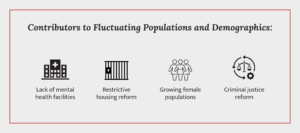
- With dedicated mental health institutions being dissolved, jails and prisons have become the default mental health facilities in our communities and states. This seems ironic to me given that research tells us long-term confined incarceration contributes to mental illness. To combat this, correctional practitioners attempt to create suitable treatment locations inside their facilities that were not originally designed for this purpose.
- Early in my career there was little attention spent on those in “solitary confinement,” even though those secure confinement areas have always yielded more serious incidents than anywhere else in the facility. As our mentally ill population has increased and are often over-represented in these areas, and we hear more stories of individuals who spent years locked in a cell 22 hours-a-day or more, increasing attention has been directed to the management of these units and those confined in them. The topic of restrictive housing reform was magnified by the brutal murder of Director Tom Clements at his front door in front of his family by an inmate who spent a long period of time in restrictive housing. Today, restrictive housing conditions of confinement, length of stay, and treatment of the mentally ill who violate institution rules have taken center stage in our federal courts.
- Growing female populations have forced jails and prisons to find space to house this growth, most often in housing units and facilities originally designed for a male population. More frequently than not, these units and facilities are supervised by staff accustomed to managing a male population. It becomes very difficult to be gender-responsive under those circumstances.
- Criminal justice reform has helped reduce the overall state prison populations in most states, but has created greater intensity of violent, disruptive incarcerated individuals. This population is not suitable to be housed in the open dormitory style housing that was so popular in the 1980s and 1990s to economically meet the bulging prison populations of the time.
- Misalignment Between Facility Design and Current Best Practices
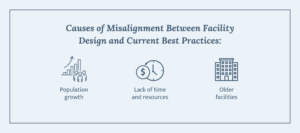
- Some states and communities are now experiencing a growth in their jail and prison populations without time or resources to design and build restorative-minded facilities aligned with current correctional philosophy. This usually results in reduced participation in programs that have been demonstrated to reduce violence in prison and reduce recidivism, which creates safer communities and less victims. Often, spaces dedicated to these programs are being repurposed to house more bodies. In some cases, increasing populations without suitable housing has resulted in triple bunking and the use of “boats” to sleep on in cells. It has been said that, “Rome was not built in one day.” That can also be said about designing and building new jails and prisons or additions to existing facilities.
- Many facilities in use – and in some cases, over capacity – were built decades earlier with a different vision and mission at that time. Program and treatment space is limited compared to today’s needs, a time where research has provided evidence regarding the value and impact of select programs. Space is often very limited in areas used for restrictive housing, which reduces out-of-cell time and invites federal litigation.
- Leadership Turnover and Staff Retention
- Turnover of correctional leaders creates substantial difficulty in both implementing change and sustaining it. Over the past five decades, the pace of change in top state leaders has accelerated. At the state level, the average length of stay for a director is 2.8 years. In that short amount of time, the leader must gain knowledge of the budget, get a grasp of the highest priority issues facing the agency, get acclimated to the governor’s expectations and begin to know and understand staff and locations in the system. That leaves little time to sustain any initiatives. With typical staff resistant to change, there is often a “wait and see” outlook by the staff responsible for implementing change. This constant disruption of leadership challenges the continuity of demonstrated programs and services.
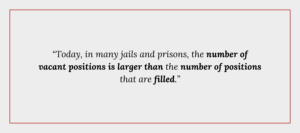
- In years past, let me say decades past, employment in jails and prisons was coveted, with multiple qualified candidates for each vacancy. On the day I started my career in Ohio’s prisons, July 1, 1974, there were 8,400 incarcerated in the state. On January 4, 2011, when I returned to become director, the population was 51,000. It takes a lot more staff and a lot more prisons to manage that number. During those years of growing populations, governments were cutting employee benefits, including eliminating perhaps the greatest incentive for employment: a retirement with a guaranteed pension. Today, in many jails and prisons, the number of vacant positions is larger than the number of positions that are filled. It used to be that the capacity of jails and prison was dictated by bed space. Now, given correctional leaders’ concern for safety, the lack of adequate numbers of staff have caused many jails and prisons to reduce facility capacity. This is a bold step but one that is critical to protect lives.
- Prevalence of Illegal Substances and Technological Threats
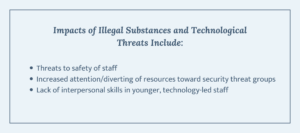
- Illegal substances that have ravaged the public have increasingly penetrated our secure perimeter and impacted our operations. The illegal drugs have become more deadly, more easily concealed, and a threat to our staff just attempting to do their job.
- The increasing influence and sophistication of security threat groups aided by the technology of drones and cell phones has required correctional leaders to devote substantial resources to defeat their threat. This focus on security threat groups often detracts from restorative programs that ultimately keep or communities safer.
- Technology continues to evolve at a pace this 72-year-old cannot fathom. New staff we are hiring have grown up with technology at their fingertips constantly, sometimes to the detriment of interpersonal skills. I was walking through a prison very recently and the warden remarked that the younger generation of staff must be taught how to talk with inmates. She said younger staff just do not know how to talk with people, let alone being able to give an incarcerated person direction. I know that being able to talk with a hostile inmate has gotten me out of some very serious situations.
- Ongoing Impact of COVID-19 Pandemic
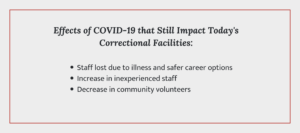
- Covid had an unprecedented impact on the operations of our correctional facilities, and its carnage ended the lives of too many staff and those incarcerated. But the influence of Covid remains with us today: significant loss of experienced staff who found other employment that did not pose the same threat to their family.
- With vacancy rates at an all-time high, and the priority to try to keep staff and those incarcerated safe, compliance with post orders was relaxed. Agencies were forced to hire just about anyone that would take the job during that time. Those new staff only knew operations with limited operation, little contact with the incarcerated population, and only a portion of the post orders being followed. It has been an extraordinary challenge to raise expectations and to motivate the staff that began their service during Covid.
- A significant contribution of correctional programs comes from community volunteers. Our jails and prisons were off limits to the outside world during the pandemic. It has taken a remarkably long time for many systems to regain support from these community sources.
I realize those reading this could add many more operational challenges than is contained in this summary above. However, these are some of the most prevalent themes impacting the operations of our justice facilities today and are all examples of areas I’ve found great guidance on through my involvement in impactful professional organizations like the American Correctional Association.
Accreditation: A Tool to Navigate Turbulence
On the day I met with Governor Kasich and decided to accept the role of Director, he challenged me to, “Go reform the most unreformed part of government.” I think we have established that the challenge of managing correctional facilities has never been more demanding. In fact, an easier leadership path would be to adopt one of the approaches below:
- “Roll with the punches”
- “Out of my control”
- “Take what they give me”
- “I have two years and a wake-up and I will be out of here”
- “This too shall pass”
I know you have heard these things from some people, but if you have made it this far through this blog post, you are a correctional leader – and true leaders would never take these approaches. Like I mentioned, over the course of my career, I’ve leaned heavily on my learnings from the American Correctional Association (ACA).
Twice a year, correctional professionals from wide-ranging disciplines and from all types of correctional environments meet to create, revise, combine, or abolish standards that guide correctional leaders. In fact, every standard and expected practice for every correctional entity has been developed by a correctional professional and endorsed by a majority of members of a diverse national committee. These are truly the accepted practices for our profession that give us direction through some of our greatest challenges. These also provide justification for what we do and how we do it when litigation knocks on our door or politicians attempt to make headlines at our expense.

In 2024, Gary Mohr received the E.R. Cass Correctional Achievement Award from the American Correctional Association. The E.R. Cass Award is the highest honor in corrections, recognizing individuals who have demonstrated outstanding contributions to the field and whose impact resonates throughout the industry.
ACA Performance-Based Standards and Expected Practices for Correctional Facilities
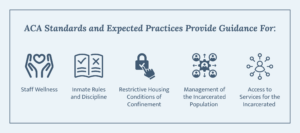
Performance standards and corresponding monitoring processes provide a solid foundation for practitioners to use in some of our most demanding and important operational areas. To give you an idea, here is just a taste of the significant areas for which the standards provide guidance for today’s leaders:
- Staff Wellness
- Staff training
- Space and equipment
- Engagement surveys
- Safety techniques (including self-defense and deescalation)
- Critical incident response teams
- Linkage to support programs
- Compensation and benefits
- Inmate Rules and Discipline
- Rules of conduct
- Criminal violations
- Disciplinary reports and hearings
- Appeal process
- Restrictive Housing Conditions of Confinement
- Who is appropriate for restrictive housing?
- Separate and independent review of placements
- Mental health screening and periodic reviews
- Supervision and rounds by security, managers, medical, mental health and program staff
- Clothing, shaving, showers, barbering, laundry, hygiene items
- Cell unencumbered space
- Access to outside recreation
- Reentry to general population and to the community
- Periodic reviews
- Management of the Incarcerated Population
- Grievance procedure
- Use of restraints
- Transfers
- Special needs
- Suicide prevention
- Access to Services for the Incarcerated
- Treatment plans
- Mental health services
- Medical evaluations, screenings, and treatment
- Chemical dependency treatment
- Educational programs
- Pregnancy services
- Communicable disease control
- Religious programming
- Library services
- Mail, telephone, and visiting
- Food service
Remember, this is just a taste of the hundreds of performance-based standards and expected practices that support correctional leaders to ultimately be accredited by the largest organization in the world that accredits correctional facilities.
The Big Picture
Compliance with the ACA Performance-Based Standards and Expected Practices [90% compliance with non-mandatory standards and 100% compliance with mandatory standards] leads to being recommended by an experienced audit team and ultimately receiving national accreditation awarded by a panel at an American Correctional Association conference. Accreditation comes with a large certificate suitable for framing and posting conspicuously in the facility but there is much more.
Accreditation has been criticized by some in elected office as a weak, non-substantive assessment of jails and prisons. There have undoubtedly been facilities over the years that have slipped through the process that should not have been accredited. During my tenure as president of the American Correctional Association, this was a priority to address. To ensure ACA accreditation is truly meaningful, within the three-year accreditation period, facilities will receive non-announced site visits by certified auditors to ensure compliance with the standards is sustained. Further, I can assure you that no one that has stood as a warden, jail administrator or accreditation manager would ever say that this process is “weak.” The preparation – including accumulating documentation, preparation of the physical plant, daily practices that ensure compliance – is intense and requires a complete team effort from staff and those incarcerated.
I have been a warden of a facility that has been initially accredited and reaccredited. I also attended every panel hearing for every Ohio correctional facility during my tenure as director. There is nothing I’ve witnessed in my 51 years of experience that brings staff and those confined together in a united effort to not only pass the accreditation audit but to show off their facility to national experts like this process.
In 1998, I served as a prison warden of Ohio’s largest prison. This facility, built in the 1920s, was the last one in Ohio to go through the accreditation process. I still have the images of staff and inmates in flower gardens planting flowers and spreading mulch all over the compound. On the third day of the audit, when the assessment was complete, we filled our beautiful chapel with over 200 in attendance to listen to the auditors talk about our facility and state that they were recommending us for accreditation. It was an emotional day for this warden. Staff and inmates celebrated. This uplifting experience positively carried our facility for months. In fact, there is a person who served as a captain at that facility that I see regularly when I attend our local American Legion Post. He still always pats me on my back and says “we did it,” even after 28 years.
Download the PDF
Meet the Author