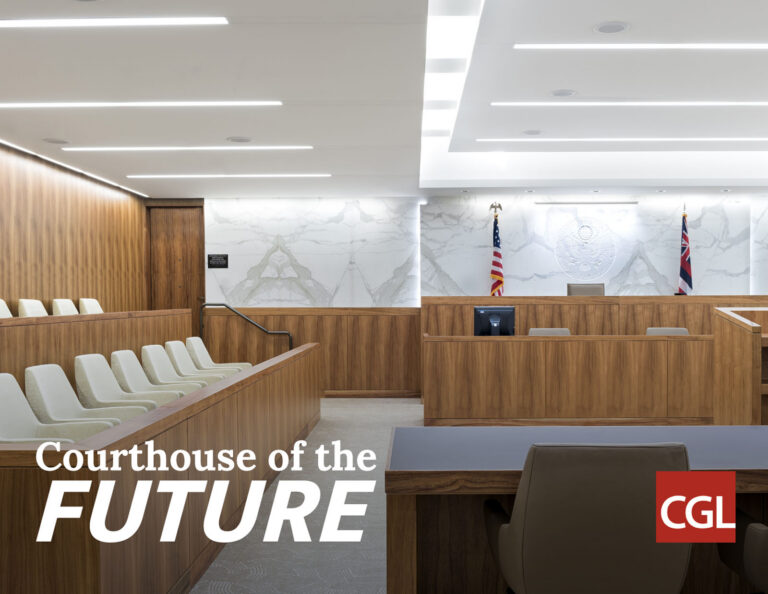

Beyond the Building — Three Ways Today’s Courts are Building Trust
I’ve spent a good part of my career working on courthouses—some of the most complex, high-stakes public buildings you can design. If there’s one thing I’ve learned, it’s that trust isn’t something you can draw into a set of plans. You don’t build it with stone or glass. You build it in the way people feel when they walk through the doors—whether they know where to go, whether they feel safe, whether the space tells them they matter. As architects, we’re trained to focus on good design, and we often lean on a language of proportion, light, and material – but trust asks something more of us. It lives in the social dynamics of a space, the perspective of those who walk through it, and the often messy, deeply human processes unfolding inside. Not many are eager to take that on directly—but over time, project after project, it has become a foundational pillar of every courthouse story.

At the Multnomah County Courthouse, the experience of the building begins with how it feels to move through it—open, intuitive, and welcoming.
How Do We Define “Trust” When It Comes to Courts?
Trust is hard to pin down — you won’t find it in a spreadsheet, but you’ll see it in the people who interact with the court system. Recent Gallup surveys show one of the sharpest declines in public trust in U.S. courts, and this drop isn’t tied to any specific leadership or decision. While trust in other public institutions has remained relatively stable in recent years, the judiciary seems increasingly out of sync with the public it serves.
More concerningly, the safety of judicial officers and court facilities has become a top priority in both planning and day-to-day operations. According to the New York Times, threats to federal judges have more than doubled in the last months[1]. The reality is that when public trust breaks down, threats and attacks tend to rise — and courts are feeling that pressure. At the same time, many are grappling with a shrinking workforce and trying to do more with less. But meaningful change is slow. So, what can institutions do to reverse this trend?
This shift is unfolding just as many courthouse facilities across the country are reaching the end of their useful lives. When renovation or replacement finally becomes possible, it creates a once-in-a-generation chance to do more than update systems or meet code. It’s an opportunity to step back and ask bigger questions: What do people actually need from their courts today? And how can the spaces we design reflect those needs—not just functionally, but with empathy, clarity, and purpose?
Strategies for Building Trust Moving Forward
No two communities are the same, but there are three strategies I’ve seen time and again that help shape the path forward:
- Access to Information;
- Access to Court Facilities;
- Access to People
Let’s review each of these strategies, taking a closer look at important components they entail:
STRATEGY 1: ACCESS TO INFORMATION
When someone engages with the court system for the first time, their initial impression is shaped by how easy it is to find information—long before they even step inside the building. Questions like “Where do I go? What do I bring? When is my hearing?” are on the minds of most court users. To address this, courts rely on three key approaches: user-friendly digital platforms, clear and understandable information, and communication across multiple channels and formats to reach all audiences.
Digital Platforms: Why They Matter

Centralized case management systems and public digital platforms have become the primary access points for both the public and court staff, making it easier than ever to find case information, file documents, and check court schedules online. The federal court system alone processed over 41 million cases through its CM/ECF system in 2012, with more than 700,000 users filing electronically each year (U.S. Courts, 2012). Modern systems now integrate real-time updates, automated alerts, and even AI-assisted workflows to streamline court operations and improve transparency. When executed properly, these systems improve public trust in three meaningful ways:
-
- Increased operational efficiency through automation: Web-based tools for docketing, document handling, participant tracking, and payment processing can help streamline court workflows. This improves staff productivity, reduces errors, and speeds up case processing.
- Consistency through standardized processes: Standardizing case procedures across courts within the same jurisdiction ensures that users receive the same clear, reliable experience regardless of location. It also simplifies training, staff mobility and flexibility and supports fair treatment.
- Expanded public access and transparency: Online access to court records and status updates empowers litigants, attorneys, and the public to stay informed anytime. Transparency fosters trust and reduces questions or misunderstandings. The information is no longer siloed and safeguarded at a central location, outside of the participants’ reach.
Finding It Is Step One — Understanding It Is Step Two
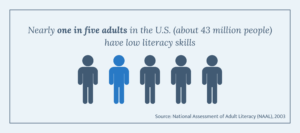
Once the information is located and accessible, the next step is to make it easy to understand. This is especially important because nearly one in five adults in the U.S. (about 43 million people) have low literacy skills, according to the National Assessment of Adult Literacy (NAAL), 2003 [2]. Many court users struggle not just with reading complex legal language but also with understanding procedural terms, filling out forms, or navigating digital portals. This just scratches the surface of how courts serve a broad range of clients, with varying levels of legal knowledge, language proficiency, and mental or developmental abilities. While one size will not fit all, a helpful way to start framing the conversation begins with asking the right questions:
-
- To what extent are court materials—both online and in print—designed to be easily understood by users of all reading levels?
- To what extent are court services and materials accessible to users across different languages and cultural backgrounds?
- How effective is the court’s delivery of information accessing people with cognitive, developmental or physical disabilities?
- How confident are staff in recognizing special needs and using trauma-informed communication to guide individuals?
- What percentage of court users with limited legal knowledge clearly understand the requirements and steps at each stage of the court process?
Once those questions are clarified and quantified, we can then target focused strategies to mitigate the gaps and ensure that the information is received and processed in a meaningful way to enable participants to engage in the process of their cases.
Deliver Clearly, Reach Widely
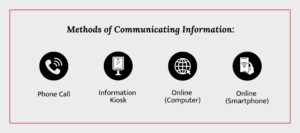
No matter how advanced technology becomes, we have yet to see it entirely replace people in courts. Instead, we’re seeing systems emerge to automate repetitive processes, allowing human resources to focus on the areas where their impact matters the most. The challenge comes with finding the right mix of technology and personal support, ensuring that the multiplicity of communication doesn’t cause confusion. Providing options—like a phone call, an information kiosk, or online access on a through a computer or smartphone—respects individual choice and helps make the court process more approachable and manageable.
At the same time, courts can’t (and shouldn’t) do it alone. There are moments when the support people need goes beyond what the court can offer. That’s where nonprofits and community organizations become essential partners. By working hand-in-hand, courts and communities build a stronger safety net that helps people get the care and resources they truly need. This approach values compassion and sees people as whole individuals, not simply cases to be processed.
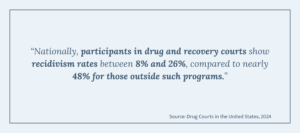
Treatment courts exemplify this collaborative model. Rather than focusing solely on enforcement, they prioritize healing. By connecting people struggling with addiction or mental health issues to real support like counseling and medical care—and guiding them through the legal system with respect and care—treatment courts reduce recidivism rates significantly. Nationally, participants in drug and recovery courts show recidivism rates between 8% and 26%, compared to nearly 48% for those outside such programs (Drug Courts in the United States, 2024)[3]. In North Carolina, recovery courts save roughly $6,000 per participant annually (North Carolina Judicial Branch, 2022)[4], a fraction of the $54,000 it takes to incarcerate an individual for a year (North Carolina Department of Adult Corrections, 2024)[5], making these programs both effective and cost-efficient. Treatment courts show what is possible when courts and communities come together to create a system that is not just fair, but genuinely supportive and trustworthy.
STRATEGY 2: ACCESS TO COURT FACILITIES
Addressing court facilities doesn’t start at the architectural design stage; this is usually done during capital planning and master planning, where system-wide strategies like centralizing or distributing facilities and other overarching decisions are made. Courts have specific needs, the public has expectations, and budgets and land use must be managed carefully. These priorities rarely align easily. Success depends on balancing institutional presence with community connection, offering accessible public programs, and creating safe, transparent spaces. Key considerations include where to locate operations, how to assign departments, and designing adaptable spaces for current and future needs.
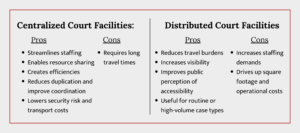
Centralized or Distributed? From Central Hubs to Local Access Points
The decision to centralize or distribute court facilities is one of the most consequential in long-range planning. It requires balancing public access with staff efficiency and security logistics—particularly when it comes to the movement of in-custody individuals.
Centralized facilities offer significant operational advantages. Co-locating multiple court functions under one roof can streamline staffing, enable resource sharing, and create efficiencies in areas like security screening, public service counters, technology infrastructure, and administrative support. For court staff and justice partners, this model can reduce duplication and improve coordination. It also minimizes the need to move in-custody individuals across multiple unsecured sites—lowering both security risk and transport costs.
But centralization can come at a cost to accessibility. In large or rural jurisdictions, a single facility may require long travel times for many residents. For those without reliable transportation, these distances can be a serious barrier to participation—especially for low-income individuals or those with caregiving responsibilities.
Distributed models, by contrast, bring services closer to where people live and work. Satellite courts, shared civic centers, or community-based locations can reduce travel burdens, increase visibility, and improve public perception of accessibility. These models are particularly useful for routine or high-volume case types, such as traffic, family, or housing matters, where in-person interaction is still necessary but full courthouse infrastructure is not always required.
However, distributed models often come with trade-offs. By spreading operations across multiple sites, courts may need to duplicate staff support spaces—such as break rooms, file storage, IT rooms, and administrative zones—that could otherwise be shared in a centralized facility. This not only increases staffing demands but can also drive-up square footage and operational costs. Mechanical systems, security checkpoints, and facility management services must often be replicated, expanding both the physical and financial footprint of the court system.
Ultimately, the decision isn’t binary. Many jurisdictions find success with a hybrid approach—centralizing higher-security or high-volume functions while distributing public-facing or community-based services. The key is to align the facility model with local geography, population distribution, security needs, and the ability to deliver consistent, high-quality service across locations.
Factoring Public Access into Site Selection
Where a courthouse is located can influence who shows up, and who doesn’t. Locations near public transit, walkable areas, and community services increase accessibility—especially for people without reliable transportation, flexible work schedules, or proximity to legal services. Inaccessible sites can deter public participation, compounding legal and personal challenges. Site selection, when done properly, takes the operational and human factors into account and reduces friction to encourage engagement.
Early conversations rarely give enough weight to demographic and geographic data, even though they’re essential to making informed siting decisions. Understanding where court users live, their average commute times, and concentrations of vulnerable populations—such as those with unstable living conditions, lower income, or no access to a personal vehicle—helps ensure that facilities are placed within practical reach of the communities they serve.
Infrastructure and road access also play a major role in the short- and long-term success of judicial facilities. Courts should be easy to find and reach, whether someone is coming by car, bus or on foot. This includes analyzing traffic patterns, highway access, and road safety, especially for peak hours of court activity. Available public transportation, routes, schedules, and proximity to stops, can determine whether people can make it to court at all. And let’s not forget parking—limited or costly parking options create real barriers, particularly for jurors, self-represented litigants, and families accompanying others. Planning for adequate, free or validated parking is part of delivering equitable service.
In rural or remote areas, distance itself becomes the challenge. People may need to travel over an hour to reach a courthouse, and weather or unreliable transit can easily prevent attendance. In these situations, satellite locations or mobile services can dramatically improve access.
Finally, access doesn’t end at the edge of the site. Effective on-site circulation—clear signage, accessible drop-off areas, pedestrian pathways, and a welcoming, intuitive entrance—shapes the user’s first impression. A facility may be well located but still feel unapproachable if the path to the door is unclear, inconvenient, or uncomfortable. Visitors should be able to navigate to the building with ease, whether they are arriving for jury duty, family court, or to access support services.
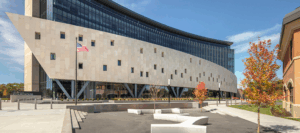
Thoughtful site design at the Johnson County Courthouse supports clear circulation and welcoming access, with defined pedestrian pathways, accessible drop-off zones, and intuitive entry points.
Balancing Institutional Presence with Community Connection
Courthouses serve as pillars of authority, yet they must also feel connected and relevant to the communities they serve. Achieving this balance is crucial to building public trust and fostering a welcoming environment. One key approach is integrating court services within the broader community and civic campus. Offering quality transitional spaces such as plazas, green areas or walkways, accessible even beyond court hours, invites the community to engage with the site on their own terms. These shared spaces blend social interactions and reinforce the courthouse’s role as a community partner.
Being a good neighbor also means ensuring the building feels right within its place and community. This requires careful attention to the building’s tone, its transition in scale and form, the use of landscaping and buffers to soften edges, and consideration of how the facility appears from surrounding homes and streets. When approached with care, these buildings not only blend into the neighborhood from the inside out but also consider the outside-in perspective to support people navigating court and social services.

The Flagstaff AZ Municipal Courthouse (pictured above) was purposefully designed to match the context and historic feel of downtown Flagstaff, including use of Sedona sandstone/red brick.
Engaging the ground floor with the surrounding pedestrian fabric is essential to making courts approachable and connected to the community. Thoughtful design ensures that sidewalks, plazas, and entrances invite foot traffic and create seamless transitions between public spaces and the courthouse. Distinctive architectural cues and clear signage mark the presence of the courts and highlight main entry points, guiding visitors intuitively while reinforcing the building’s important role. Together, these elements make the courthouse both welcoming and unmistakably present, supporting a sense of neutrality and respect.
Equally important in designing these transitional exterior spaces is careful attention to the environmental comfort and sensory experience. Providing ample shade through trees, canopies, or pergolas not only creates refuge from sun and heat but also encourages people to linger and engage with the space. Thoughtful landscaping can act as a natural buffer against noise from nearby streets or parking areas, enhancing the sense of calm and safety. Materials and textures chosen for walkways and seating areas contribute to a comfortable and inviting atmosphere, while lighting design ensures these spaces remain accessible and secure during evening hours. By addressing these environmental factors, courthouses can offer exterior spaces that truly support community gathering and reflection of any individuals, at any time of the day.
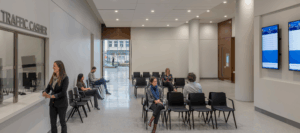
The Will County Courthouse places public services and waiting areas near main entry to help visitors find what they need quickly and with less stress.
Planning Principle: Public-Facing Programs at Public-Facing Locations
Continuing the journey of approach, public vestibules, queuing areas, and security screening serve as the gateway to ground-floor programs. Building layouts play a crucial role in navigation ease. Aligning public entrances, service counters, and waiting areas consistently across floors helps users maintain orientation regardless of where they arrive. Clear signage, intuitive wayfinding systems, and open sightlines further support this goal.
Intuitively, high-foot-traffic functions are best located on lower levels, sometimes connected by dedicated stairs and escalators. This strategy reduces travel times and allows elevators to focus on transporting visitors to courtrooms and specialized functions on upper floors, while transactional interactions remain conveniently accessible below. Access to certain public functions after hours should also be carefully considered, ensuring secure but flexible entry points for community programs that may operate beyond typical court hours.
In addition to interior planning, exterior design elements like window placement and shading can create a welcoming atmosphere in public spaces. Meanwhile, circulation paths for staff and judges require additional security layers and screening, often necessitating separate entrances and controlled access points.
A building that is easy to read, navigate, and feels neutral can significantly reduce stress for visitors and help prevent crowding. Mapping decision points along the visitor’s journey and identifying potential sources of confusion—sometimes through virtual walkthroughs—can provide valuable insights early in the design process. This proactive approach helps ensure informed decisions are made well before construction begins, ultimately creating a more welcoming and efficient courthouse experience.
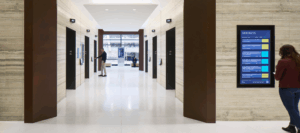
Clear wayfinding, visual cues, and defined spatial boundaries help visitors feel oriented and supported as soon as they enter.
A Space You Can See Into — and Feel Safe Within
We are far beyond equating transparency with simply using glass and openness. True transparency in courthouse design means creating spaces where people—notably an aging population facing increasing cognitive challenges and individuals of all ages affected by trauma—feel safe, supported, and able to navigate confidently. Trauma, especially in children, can significantly impact cognitive function, making spatial understanding and memory even more important. The brain forms cognitive maps—mental representations of space—using visual cues, spatial boundaries, and environmental landmarks to orient and guide us. When these cues are unclear or misleading, disorientation can quickly occur. Multiple studies emphasize how clear visual cues and well-defined spatial boundaries create environments that look at wayfinding beyond signage, logical patterns that ease navigation without confusion (Wayfinding: People, Signs, and Architecture, 2002).
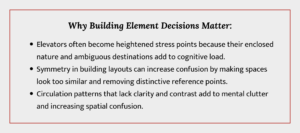
When it comes to building element decisions, elevators often become heightened stress points because their enclosed nature and ambiguous destinations add to cognitive load, especially for those with impaired spatial memory. Symmetry in building layouts, while visually balanced, can increase confusion by making spaces look too similar and removing distinctive reference points. Circulation patterns that lack clarity and contrast further impair the brain’s ability to form accurate cognitive maps, adding to mental clutter and increasing spatial confusion. Thoughtful wayfinding with clear signage, varied landmarks, and logical routes helps users navigate efficiently and with less stress.
Regarding material selections, visual clutter and reflections from glass surfaces can disrupt spatial orientation and contribute to mental overload. Employing a simple but consistent color strategy with high contrast aids in defining spaces and guiding movement. Avoiding heavily textured or overly glossy materials reduces visual noise, making environments calmer and easier to read. Whenever possible, using visuals such as icons or graphics to supplement or replace text improves comprehension, especially for visitors with diverse language skills or cognitive challenges. These material choices support the brain’s ability to form clear cognitive maps and enhance overall accessibility.
STRATEGY 3: ACCESS TO PEOPLE
Court facilities have always depended on people—judges, clerks, security officers, and support staff—to keep operations running smoothly. But today, their roles are expanding in response to changing community needs, technological advances, and a deeper understanding of the human experience within the justice system.
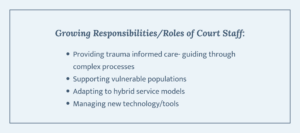
More than ever, court staff are not just processing cases or maintaining security; they’re providing trauma-informed care, guiding individuals through complex processes, and supporting vulnerable populations with empathy and respect. They’re adapting to hybrid service models that blend in-person and remote interactions, while managing new tools like chatbots and virtual appointments.
This shift means the design and operation of court facilities must evolve to support these changing functions—creating spaces for privacy, wellness, and flexibility, and ensuring staff have the resources they need to provide compassionate, effective service. As courts become more user-centered, the people who work within them are at the heart of that transformation.
People Want to Be Heard, the Right Way
One of the most fundamental needs of individuals interacting with the court system is the opportunity to be heard. Research has shown that when people feel they have been heard and treated with dignity and respect, they are more likely to perceive the process as fair, regardless of the outcome. The California Courts’ study on procedural fairness emphasizes that “listening carefully to what people have to say” is a critical component of perceived fairness in court proceedings.
This principle is particularly important for marginalized communities, including those experiencing trauma or navigating the system without legal representation. The disposition of judicial staff to listen attentively, use appropriate and clear language, and handle interactions with empathy is crucial in fostering trust. Equally important is the ability of individuals to express not only facts but also their opinions and feelings, as this fuller expression influences perceptions of fairness and respect.
The use of nonverbal communication that aligns with and supports the verbal message is critical—contradictory or self-soothing behaviors can undermine trust and create confusion. Examples of nonverbal communication include facial expressions, the speed, pitch, and volume of speech, use of gap-fillers like “uh” and “umm,” gestures, posture, attire, eye contact, and the physical distance between speaker and listener. It is essential to recognize that these cues vary across cultures; some may find direct eye contact engaging, while others may perceive it as intrusive or disrespectful. Sensitivity to these differences helps create a more inclusive and respectful court environment, encouraging people to feel truly heard and valued.

Spaces Must Be Designed with Purpose in Mind
Equally important is thoughtfully designing the separation between staff and visitors, which varies depending on the nature of the interaction and the level of risk involved. Different settings call for different degrees of separation to balance security, privacy, and accessibility. For routine transactions such as filling out forms or providing general information, open or semi-open spaces encourage approachability and ease of communication, fostering a welcoming atmosphere.
At the same time, the need for privacy—such as in private interview rooms or sensitive consultations—requires settings that offer confidentiality and discretion, distinct from open or semi-open areas. These spaces must be carefully located and designed to provide soundproofing, visual privacy, and a calm environment, ensuring individuals feel safe to share personal information without fear of being overheard or exposed.
When interactions involve handling cash, valuables, or sensitive information, greater physical separation becomes necessary to protect both staff and visitors. Courts must carefully assess the risk associated with each service type and design spaces accordingly, ensuring security measures are proportionate and do not create unnecessary barriers that could intimidate or alienate users.
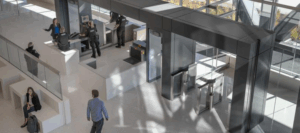
Thoughtfully designed entry screening at the Johnson County Courthouse balances safety with openness, ensuring security measures feel clear, efficient, and welcoming rather than intimidating.
Don’t Forget to Balance Out Stress with Wellness
Dedicated wellness spaces are essential in high-stress judicial environments, where employee well-being directly impacts performance, retention, and satisfaction. Attrition in courts leads to lost institutional knowledge and higher onboarding costs, as replacing experienced staff means losing critical understanding of court processes and relationships. According to the Society for Human Resource Management, turnover can cost up to 60% of an employee’s annual salary due to recruitment and training expenses [7]—an issue especially pressing in courts, where continuity is vital for fairness and efficiency.

Recent data from general workforce studies, including Wellable’s 2024 report and research by Workhuman and Gallup[8], show a sharp increase in wellness program adoption, with 91% of organizations planning to invest more in mental health and stress management. These studies also highlight improved job satisfaction, productivity, and reduced absenteeism among employees with access to wellness programs. However, it’s important to note these findings are based on broad industry surveys and not specifically focused on judicial settings.
While breakrooms are standard in many courts, only a few jurisdictions—like Virginia—have formally integrated wellness into facility standards. Codifying staff needs throughout the day, especially for those regularly facing high-stress situations, is key to building a healthier, more resilient workforce. This includes designing dedicated wellness spaces such as quiet rooms and fitness areas, providing ergonomic workstations, ensuring access to natural light and outdoor breaks, and creating social spaces to encourage positive interaction—all proven to reduce stress and improve job satisfaction in demanding judicial settings.

Dedicated staff spaces—like this light-filled break area—support mental well-being, encourage positive interaction, and help build a healthier, more resilient courthouse workforce.
Always Plan for Emergencies
Supporting every possible circumstance requires careful planning for emergency operations. Building in redundancy, creating clear separation between different groups, and fostering a strong sense of safety are essential to protect all individuals involved. Equally important is having a deep understanding of how operations function during emergencies and establishing a well-communicated emergency plan that everyone embraces. This foundation ensures that, no matter the challenge, responses are coordinated and effective, helping maintain order and safety throughout.
More Trust = A More Effective Courts System for All
In short, to effectively build trust and support within court systems, it’s essential to prioritize accessible information, thoughtful facility design, and comprehensive staff wellness. Balancing operational efficiency with public access, while designing spaces that promote safety, clarity, and dignity, creates environments where both users and staff can thrive. Equally important is planning for emergencies with clear protocols and separation strategies that protect everyone involved.
Access our Comprehensive Self-Assessment Toolkit—a practical starting point to measure your court’s impact on building trust within the judicial system. Answer these questions honestly and if your court rates “Emerging” or “Needs Attention”, it may be time to schedule an assessment of your court operations.
Sources:
- https://www.nytimes.com/2025/05/27/us/politics/federal-judges-threats.html
- https://nces.ed.gov/naal/
- https://archive.legmt.gov/content/Committees/Interim/2015-2016/Judicial-Redistricting/Meetings/Feb-2016/Exhibits/nadc-research-update-drug-courts-jrc-feb-2016.pdf
- https://www.nccourts.gov/news/tag/general-news/north-carolinas-8th-judicial-district-receives-federal-funding-to-create-adult-recovery-court
- https://www.northcarolinahealthnews.org/2025/08/06/more-than-1-in-4-people-released-from-nc-prisons-faced-homelessness-in-2024/
- Arthur, P. and Passini, R. (2002) Wayfinding: People, signs, and architecture. Oakville, Ont: Focus Strategic Communications.
- https://www.shrm.org/topics-tools/news/hr-magazine/drive-turnover
- https://www.workhuman.com/resources/reports-guides/amplifying-wellbeing-at-work-and-beyond/
Meet the Author