
Beyond Siloed Planning: An Integrated Approach to Justice Facility Projects
It’s a story we have all seen play out many times:
- An agency announces a bold new initiative or project to address longstanding issues or needs in the criminal justice system.
- After a lengthy planning process, the initiative, be it a new program or facility, is completed and operationalized.
- Despite some notable improvements, within a few months, it becomes plain that key benefits promised for the project have not been attained. In fact, many of the issues that led to the project still persist.
- Disillusionment and frustration set in amidst a search to assign blame for the project’s failure to reach its objectives.
Why does government so often seem to struggle to plan and develop effective solutions to widely recognized problems? While it is easy to blame these failures on the general incompetence of the people participating in the planning process, this charge is often unfair. A more honest examination of justice system planning will reveal serious, dedicated professionals engaged in the process who understand the nature of the problems they face, but that, nevertheless, still fail. In our experience, the issue is often not the qualifications or skill level of the staff responsible for planning a project but is instead the approach and process used to plan these initiatives.
The Issue with Silos in Justice Facility Planning
Justice agencies spend enormous amounts of time and energy working on plans to respond to operational challenges, program needs, and facility needs. The work behind these efforts is often data-driven, well-intentioned, and performed by experienced staff with extensive practical experience. The often disappointing results from this work are not typically due to flawed analysis or lack of effort. Instead, the problem is that, in too many cases, the planning in support of this work has been conducted along parallel tracks with staff working in silos. None of the individual decisions or work products produced in these silos is irrational. In isolation, each may be perfectly defensible.
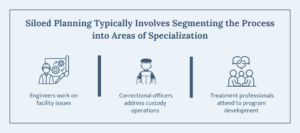
Most often, silos are not the product of incompetence or bad intentions. They instead reflect an assumption that the most logical, efficient approach to planning requires segmenting the process into areas of specialization. Engineers work on facility issues, correctional officers address custody operations, treatment professionals attend to program development… and so it goes. This approach makes intuitive sense and provides a clear, well-defined approach to addressing project issues. Experts work on the issues that they know best.
One of the primary perceived benefits of this approach is its efficiency. Agencies often treat planning as a necessary initial step in a process that needs to be completed quickly and with minimal fuss, so to expedite actual achievement of the project. The priority is to get past the planning stage as soon as possible and into development and implementation. To that end, segmenting the planning process by subject matter allows experts in those specific areas to efficiently leverage their knowledge. They are already high on the learning curve so they understand the subject area and can move more quickly to the development of solutions. In this approach, the most expeditious path forward to a successful plan is for assigned staff to work exclusively in their area of subject matter expertise.
Siloed planning can seem attractive because it breaks down a problem into its component parts, which are (in theory, at least) easier to attack in isolation from the more complex system in which they reside. It’s a common approach throughout life – taking a complex problem and developing a solution by breaking it down into smaller, simpler components that are easier to address. Simple problems can, in fact, often be addressed by simple solutions. Unfortunately, that is not the policy world of the criminal justice system. The issues we face as criminal justice professionals are complex and touch multiple different facets of government and society. The planning process needs to be informed in the same manner.
Examples of siloed planning that produces problematic outcomes are not difficult to find:
- Housing capacity that is inconsistent with the classification profile of the population.
- Staffing models built around outmoded operational realities.
- Policy and program initiatives that lack the infrastructure needed to make them effective.
- Facility designs that cannot readily be adapted to changing circumstances.
A policy team may champion expanded diversion programs because the evidence suggests they reduce recidivism and improve outcomes. Those conclusions may be entirely correct. But unless operational leaders are part of the conversation, relatively small policy changes can produce significant downstream effects on inmate classification, housing assignments, transportation requirements, or programming schedules that were never fully expected.
Why Siloed Planning Fails Justice Agencies
None of these outcomes reflect poor judgment or are rooted in incompetence. Each siloed group may provide a rational answer to the question posed to them. The problem is that each group is answering a different question. The process optimizes planning for individual functions while inadvertently making the system less effective. That’s the paradox of siloed planning. Everyone can be doing exactly what they’re supposed to do, and the institution can still drift in the wrong direction. Organizations rarely fail because they lack intelligent people. More often, they fail because intelligent people are asked to solve isolated problems instead of interconnected ones.
Similarly, siloed planning makes effective response to contingent events more difficult. By adopting a narrow, blinkered approach to analysis, siloed plans tend to be blind to unforeseen developments and accordingly lack the ability to adapt as conditions change in ways that make prior assumptions inaccurate. As Mike Tyson once said, “Everybody has a plan until they get punched in the face.” The list of plans that could not withstand contact with reality is long. Failure to consider the myriad ways in which unforeseen developments can impede, or even derail, a meticulously developed plan is among the chief reasons that plans fail.
In real-life planning, we often see the siloed approach play out, with staff assigned to operations, program development, and facilities focused on their respective areas of expertise, with little emphasis on communication across functional areas. Their perspectives on the entire planning process are limited to their specialized areas. While these perspectives are legitimate and grounded in their experience, they represent specific aspects of a project or initiative that has multiple dimensions. To better inform the planning process, these perspectives need to be in dialogue with each other. This facilitates an integrated approach to planning that brings multiple areas of expertise together in a holistic approach to the issues that need to be addressed.
A Better Approach – Integrated Justice Planning
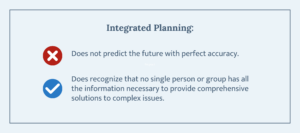
Integrated justice planning is not about predicting the future with perfect accuracy. It instead recognizes that no single person or group has all the information necessary to provide comprehensive solutions to complex issues. A process that brings multiple complementary perspectives to an issue widens the lens to address the broader set of factors that need to be addressed in the planning process. Rather than simplify an issue, an integrated planning process recognizes the complexity inherent in major projects and looks to ensure that all aspects of the project and their interaction are considered.
This approach recognizes that as today’s correctional environment grows ever more complex, every consequential decision sends ripples throughout an organization. Consider the following factors:
- Behavioral health needs continue to grow.
- Medical acuity has increased.
- Coordination with specialty courts, treatment providers, community supervision agencies, and healthcare partners require time and expertise.
- Transportation demands, administrative reporting, and compliance responsibilities have all expanded.
- A revised inmate classification standard isn’t simply a change in language; it’s a change in housing assignments, data system management, inmate movement patterns, and supervision requirements.
- Expanding treatment programs may be sound public policy, but it also changes scheduling, transportation, staffing, and the availability of program space.
- Diversion initiatives alter booking volumes. Bail reforms reshape detention populations.
- Behavioral health initiatives increase demands on medical personnel and clinical services.
- Specialized courts influence release patterns and case management.
Operations, programs, and facilities do not exist in isolation. Nearly each notable change created by a new initiative or project creates corresponding changes throughout an agency or justice system that require coordination and must be considered in the planning process. Change-produced complexity has a way of compounding throughout a system. Integrated planning acknowledges this reality.
Integrated Justice Planning in Practice: Belknap County’s Jail and Community Corrections Plan
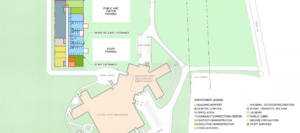
What does integrated planning look like when it moves from concept to an actual project? Our work with Belknap County, New Hampshire offers a useful example.
The County came to us with a familiar problem: an old, outmoded jail that no longer met its needs. A siloed response would have been easy to predict. Facilities staff would document the building’s shortcomings, someone would project the number of beds required, and an architect would design a larger version of the facility the County already had. Each step would be defensible. Together, they might have produced an expensive new building that answered the wrong question.
Instead, the County framed a broader question from the start. It wanted a plan for replacing the jail that would also establish a viable community corrections component. That framing put policy, operations, programs, and facilities on the table at the same time.
The work began not with square footage, but with people. During an analysis and planning phase, we evaluated the characteristics of the correctional population and the trends shaping it to determine housing needs across the full continuum of risk and need, from secure detention to community corrections step-down beds. That analysis found that 30% of the population could be housed in a staff-secure community corrections environment.
That single finding shows why integrated planning matters. A number like that is not only a facility decision. It shapes classification and housing assignments, staffing and supervision, the programs and services each population needs, and ultimately how much secure space the County would have to build, operate, and maintain for decades. Because the population analysis came first, we were able to recommend population-specific programs and services before any design decisions were locked in.
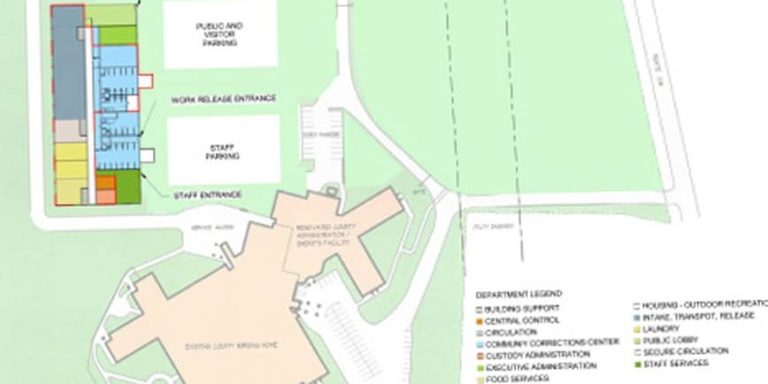
From there, each phase built on the one before it. We developed a full functional and architectural program for both the jail and the community corrections component. We tested that space program on the existing site and developed a site master plan to confirm it would fit on the county complex. Only then did we develop a full project budget estimate. No part of the plan was developed on its own track.
Just as important was who was in the room. Throughout the process, our team worked closely with the County’s Criminal Justice Coordinating Committee, ensuring a collaborative and transparent process. Coordinating committees like this one typically bring together leaders from across the local justice system whose decisions affect one another every day. Working alongside that group meant the plan was tested against multiple perspectives as it took shape, rather than presented to stakeholders after the fact.
The result was a plan grounded in a clear understanding of who the County serves, what those individuals need, and how secure detention and community corrections could function as parts of a single system rather than as separate projects. That is the promise of integrated planning: decisions that hold up because they were made with the whole system in view.
Making Integrated Planning in Justice Facilities an Organizational Discipline
Organizations plan successfully when leaders consistently connect conversations in the planning process that would otherwise remain siloed. They bring the right people in the organization together to ask better questions, challenge assumptions, and develop strategic decisions informed by multiple perspectives within the organization.
Agencies that excel at integrated planning share a common habit: they treat coordination and communication across functions and organizational walls as an ongoing and embedded characteristic of the organization. This level of integration is not a one-off adaptation of the planning process, but instead becomes an organizational discipline.
This discipline begins by broadening the planning horizon. A promising policy proposal needs to be evaluated in context with its operational implications. A facility master plan ought to include a serious assessment of future staffing requirements. Facility initiatives deserve scrutiny not only for what they solve today but for how adaptable they stay if legislation, demographics, or operational priorities evolve.
When agencies intentionally bring policy, operations, workforce planning, and capital investment into the same strategic conversation, the benefits multiply exponentially. Decisions become more durable because they are grounded in multiple perspectives. Resources are allocated with greater confidence. Facilities stay useful as missions evolve. Employees better understand how their work contributes to program goals.
Justice system agencies that succeed in the future will be those that develop a holistic approach to planning, embedding a rigorous examination of assumptions and perspectives into their analysis. Effective justice planning depends on seeing the system as a whole. When organizations replace subject matter silos with coordinated communication across disciplines, the result is more than just ‘better planning’. It’s a story of success, effective performance, and better outcomes for the public.
Download the PDF
Meet the Author