

Staffing Models for Modern Jails: Moving Beyond Headcount to Deployment Strategies That Actually Work
Over more than 40 years in detention and corrections, I’ve served as a senior administrator in several correctional centers, run a state correctional industries division as its chief executive, and led jail staffing needs analyses and correctional staffing studies for states and counties across the country. That work has taken me into facilities of nearly every size, age, and design.
Throughout my consulting career, I have helped agencies secure support for critical staffing needs by developing credible, data-driven staffing models that clearly connect operational requirements to staffing resources. My work has enabled agency leaders to present compelling, evidence-based recommendations to elected officials, budget authorities, and governing bodies responsible for funding correctional operations.
This is what modern jail staffing models are built to do, and it’s where most traditional approaches fall short.
Why Traditional Jail Staffing Models Break Down: Posts vs. Positions
Anyone responsible for staffing a jail – whether you’re a captain, lieutenant, jail administrator, or part of the command staff – has experienced it: trying to explain staffing needs to a county board, budget office, or executive team, and realizing quickly that you’re not speaking the same language.
From the operational side, the need is clear. You know how many housing units must be staffed, which posts can never go vacant, and have an idea of the number of staff it may take to safely run your facility on a 24/7 basis. But at the decision-making level, staffing is often viewed simply as a set number of positions – without a clear understanding of how those positions translate into daily operational coverage.
In my experience conducting staffing analyses across the country, this disconnect is one of the most consistent challenges agencies face – and it is a central focus of how we present and explain our recommendations. We don’t just develop staffing numbers; we ensure those numbers are clearly understood by both operational leaders and decision-makers, so they can be evaluated, supported, and ultimately implemented.
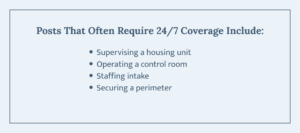
Correctional security operates on headcount, but that headcount is driven entirely by posts. A post represents a function that must be performed: supervising a housing unit, operating a control room, staffing intake, securing a perimeter. These posts must be filled consistently, often 24 hours a day, seven days a week. Where breakdowns occur is in translating those posts into staffing levels.
This gap does not just impact operations – it directly affects the workforce. When posts cannot be consistently covered, agencies rely more heavily on overtime and reassignment. Over time, this creates a cycle where high workloads and burnout make it increasingly difficult to recruit and retain staff, further exacerbating the staffing problem.
We routinely encounter situations where decision-makers assume that one funded position equates to one staffed post. Even among many detention professionals, the mechanics behind how many staff are required to sustain a post are not always fully understood or consistently applied.
The Three Components of a Defensible Jail Staffing Model
To achieve greatest clarity, staffing should be broken down into three simple, defensible components:
- What posts are required to operate the facility safely and effectively
- When and how often those posts must be staffed
- How many full-time employees are required to reliably fill those posts (‘shift relief factor’)
Just as importantly, the resulting recommendations should be translated into clear, straightforward terms that resonate with non-custody decision-makers – connecting staffing requirements directly to operational risk, consistency, and cost.
In many facilities, we find staffing hasn’t fallen behind because there are more posts that need to be filled – it’s because it now takes more people to fill the same posts. That is the role of the third component: the shift relief factor. Often misunderstood but critical to accurate staffing, the shift relief factor reflects how staff availability drives overall staffing needs.
While most agencies focus on defining posts and adjusting coverage, often changes in the shift relief factor have a greater impact on staffing than changes in posts themselves.
The Shift Relief Factor: The Heart of Accurate Detention Staffing
The shift relief factor represents the number of staff required to constantly fill a single post. For example, a shift relief factor of 1.90 for an 8-hour housing unit post means you must have 1.90 full-time employees to ensure that post is continually staffed. The shift relief factor is what translates staffing from a simple headcount discussion into an operationally accurate model. It answers a fundamental question: how many staff does it actually take to keep a post filled, every hour of every day?
At its core, the shift relief factor accounts for a simple reality: staff are not available to work every hour a post must be filled.
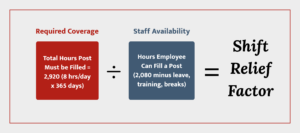
For example, a single 8-hour post must be covered 2,920 hours per year (8 hours per day × 365 days). By contrast, a full-time employee is typically available to fill a post 2,080 hours per year (40 hours per week × 52 weeks). In practice, however, their actual availability is even lower once leave usage, training requirements, and shift breaks are accounted for. This gap between required coverage and actual staff availability is what drives the shift relief factor.
The shift relief factor should be calculated based on how your facility actually operates, not a generic assumption. This includes analyzing actual facility leave usage, training requirements, vacancy and turnover impacts, and policies related to shift coverage and breaks. Each of these factors directly affects how often staff are unavailable for post coverage. The more frequently they are unavailable, the higher the shift relief factor must be.
A defensible staffing model accounts for this reduction in availability and translates into the number of staff required to maintain consistent post coverage – without reliance on overtime, post closures, or other workarounds.
Shift Relief Factors Are Rising Nationwide
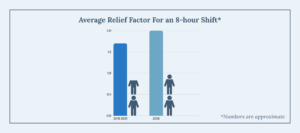
An important trend we are seeing across the country is that shift relief factors are increasing. Five to ten years ago, many agencies operated with relief factors around 1.70 for 8-hour shifts. Today, it is not uncommon to see factors approaching or exceeding 2.00.
This means it takes more staff to do the same amount of work – not because the work has changed, but because staff availability has decreased due to increased leave usage, training requirements, and workforce expectations.
One Relief Factor Doesn’t Fit Every Role or Shift
That upward trend is one reason a single, facility-wide number can be so misleading. Just as relief factors differ from agency to agency, they also differ within the same agency – by rank and by schedule. Applying a single, agency-wide shift relief factor may simplify the math – but it does not reflect how a facility actually operates.
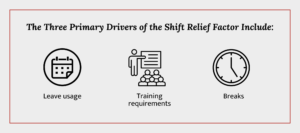
The three primary drivers of the shift relief factor – leave usage, training requirements, and breaks – vary across the staffing hierarchy. As staff gain tenure, they earn more leave and are more likely to be promoted into roles with greater administrative responsibilities and training demands, all of which reduce their availability for post coverage. Shift structure also matters. Staff working 12-hour schedules have different availability patterns than those on 8-hour shifts, which not only affects how often they can cover posts but also results in different shift relief factors for each schedule.
When these differences are ignored, staffing models can misrepresent actual availability. Developing relief factors by classification and shift type ensures staffing levels reflect how staff are truly deployed.
Facility Design Dictates Deployment: How Physical Plants Shape Correctional Staffing
The shift relief factor tells you how many people it takes to fill a post. But what determines how many posts you need in the first place? Many times, the answer is the building itself.
There are a multitude of factors that influence staffing in a correctional facility – and no two facilities operate the same way. While all must perform the same core functions – housing incarcerated persons, providing access to programs and services, and managing movement – the way those functions are carried out can vary significantly. As a result, staffing must be evaluated on a facility-by-facility basis.
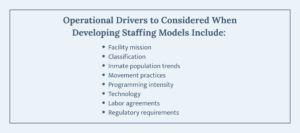
A wide range of operational drivers need to be considered when developing staffing models, including: facility mission, classification, inmate population trends, movement practices, programming intensity, technology, labor agreements, and regulatory requirements. Each of these plays a role in shaping how staff are deployed and how much staffing is required.
However, facility design consistently sits at the top of that list.
The physical layout of a facility – its housing configuration, sightlines, circulation paths, and proximity of services – directly determines the number of posts required and how staff must be deployed to maintain safe and effective operations. Facilities that minimize blind spots, reduce unnecessary movement, and co-locate services can operate more efficiently. Those that rely on long corridors, poor layouts, indirect supervision, or dispersed functions require more staff movement, more escorting, and more reactive supervision.
Post Analysis Done Right: Relief, Non-Relief, and the Posts That Drive Staffing
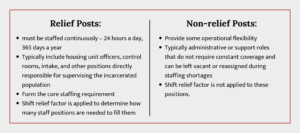
An important step in any post analysis is distinguishing between relief posts and non-relief posts – because not all posts drive staffing needs in the same way.
- Relief posts are those that must be staffed continuously – 24 hours a day, 365 days a year. These typically include housing unit officers, control rooms, intake, and other positions directly responsible for supervising the incarcerated population. Because these posts can never be left vacant, they form the core staffing requirement, and the shift relief factor is applied to determine how many staff positions are needed to fill them.
- Non-relief posts, on the other hand, provide some operational flexibility. These are typically administrative or support roles that do not require constant coverage and can be left vacant or reassigned during staffing shortages. Because they are not continuously staffed, the shift relief factor is not applied to these positions.
Off-Site Obligations and Their Hidden Impact on Internal Security Staffing
If your facility feels understaffed, the problem may not be inside your facility.
Over the past several years, one of the biggest drivers of increased workload has been medical and mental health demands. More hospital details, more outside appointments, more suicide watches – all of which require security staff. But those staff aren’t adding capacity inside the facility – they’re being pulled away from it.
Transportation is one of the clearest examples of how obligations outside the building drive demand inside it – and it points to a larger, often-invisible problem. Every transport or hospital assignment removes staff from housing units, intake, and other critical posts. The result is predictable: overtime increases, posts are backfilled with less experienced staff, or coverage is stretched thinner than intended. What appears to be a staffing shortage is often the result of staff being pulled away from the facility to meet external demands.
What has changed over the years is the frequency. A decade ago, many of these duties were considered intermittent. Today, in many facilities, they occur with such regularity that they function as permanent workload demands. As a result, staffing studies must evaluate whether these responsibilities should be reflected as dedicated posts on the roster, rather than treated as occasional assignments.
What a Jail Staffing Study Should Track
The challenge is that many agencies don’t track this well enough to prove it. To understand the true impact, agencies should be tracking:
- Why staff are leaving the facility (medical, mental health, court, etc.)
- How often it happens and how long it lasts
- How many staff are tied up per assignment
- Overtime usage – and specifically what is driving it
Without this data, it’s easy to assume the problem is internal, when in reality a significant portion of staffing demand is often being driven by obligations outside the facility – and until that demand is measured, it may not be effectively managed.
Making the Case: Translating Jail Staffing Models into Budget Realities
Once you’ve measured what it truly takes to operate the facility, the model only matters if it can survive a budget conversation. A thorough cost analysis is what makes staffing recommendations usable – not just defensible. Decision-makers don’t approve positions; they approve budgets. Even the most accurate staffing model won’t move forward unless it is translated into clear financial terms that show both the cost and the consequence of action (or inaction).
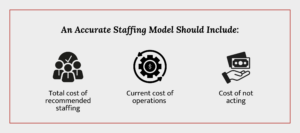
The financial picture should be framed in three ways:
- Total cost of recommended staffing – fully loaded costs, including salary, benefits, and any associated operational impacts
- Current cost of operations – particularly overtime, vacancy backfill, and inefficiencies already being absorbed
- Cost of not acting – continued overtime, staff burnout, turnover, and increased operational risk
This approach focuses the discussion on staffing as an operational and financial strategy – not just a request for additional positions.
In many cases, agencies are already paying for the staffing gap – just in less efficient ways. A clear cost analysis highlights that reality and allows decision-makers to compare short-term expense with long-term stability. This includes accounting for overtime costs that could be reduced with adequate staffing, as well as accounting for the financial and operational impact of high turnover.
Where to Start: Practical Steps Toward a Formal Staffing Analysis
If you recognize your own facility in any of this, the question becomes what to do about it. For many agencies, the challenge isn’t recognizing that staffing may be an issue – it’s getting the support to take a deeper look.
Most sheriffs, jail administrators, and command staff can see the symptoms. Overtime is high, posts are difficult to fill, and staff are stretched thin. Over time, this creates a compounding problem – heavy overtime and chronic understaffing create a cycle where workload and burnout make it harder to recruit and retain staff, placing even greater strain on those who remain and eroding the overall facility culture.
Without a clear, data-driven analysis, however, these challenges can be difficult to translate into action with decision-makers. The first step is framing the issue in a way that resonates beyond the detention or correctional facility. That often starts with clearly communicating the operational and workforce impacts:
- Persistent overtime and rising personnel costs
- Difficulty consistently covering critical posts
- Increased reliance on reassignment and workarounds
- Recruitment and retention challenges driven by workload and burnout
- Growing demands tied to medical, mental health, and external obligations
These are not isolated issues – they are indicators that staffing may not be aligned with how the facility is actually operating. From there, the conversation shifts from “we need more staff” to “we need to understand what it takes to operate efficiently, safely, and sustainably.” That distinction is critical in gaining support for a formal staffing analysis.
In many cases, agencies find that bringing in an objective, third-party perspective helps move that conversation forward. An independent assessment provides credibility, removes any concern for internal bias, and gives decision-makers a clear, defensible understanding of staffing needs.
Download the PDF
Meet the Author