

The Brain Behind the Bars: Why Objective Classification Is the Foundation of Safer, Smarter Correctional Systems
There is a moment that happens in almost every jail or prison project we work on. It usually comes after we’ve reviewed incident reports, walked housing units, spoken with line staff, and looked at bed utilization data. Someone at the leadership table will say, “We just need more max beds.”
It’s not said lightly. It reflects real concern. Assaults may be increasing. Staff may feel stretched thin. The population may look different than it did five or ten years ago. The instinct is protective – increase security, increase control, increase separation. But maximum custody housing is also the most resource-intensive type of housing a facility operates. These units typically require higher staffing ratios, specialized infrastructure, additional security controls, and more restrictive operational procedures. In many facilities, a maximum custody bed can cost significantly more to operate than a minimum or medium custody bed.
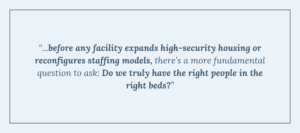
When systems expand maximum housing without first examining classification practices, they risk building or staffing expensive capacity that may not actually be needed. But before any facility expands high-security housing or reconfigures staffing models, there’s a more fundamental question to ask: Do we truly have the right people in the right beds?
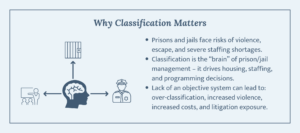
That question is not about construction. It is about classification. And classification – when done correctly – is the operational brain of a correctional facility.
Classification Is the Operating System of a Facility
Every correctional system runs on a series of interconnected decisions. Where someone is housed affects who they interact with. Housing affects staffing deployment. Custody level affects programming access. Programming affects behavior. Behavior affects reclassification. Reclassification affects facility transfers and long-term planning.
Classification sits at the center of it all.
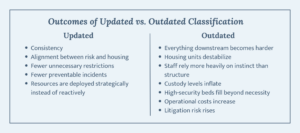
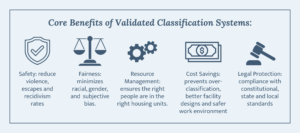
When classification functions as intended, you see consistency. You see alignment between risk and housing. You see fewer unnecessary restrictions and fewer preventable incidents. You see resources deployed strategically instead of reactively.
When classification is inconsistent or outdated, everything downstream becomes harder. Housing units destabilize. Staff rely more heavily on instinct than structure. Custody levels inflate. High-security beds fill beyond necessity. Operational costs increase. Litigation risk rises.
Classification is not paperwork. It is infrastructure.
The Problem Many Agencies Don’t Realize They Have
Most agencies have a classification process. What many do not have is an objective classification system that has been statistically validated against their current population.
There is a significant difference.
A subjective classification model relies heavily on experience, charge severity, and institutional memory. It may function adequately for years – until population characteristics shift or operational stress increases.
Subjective systems often produce three predictable outcomes:
- Over-classification
- Inconsistent custody decisions across staff
- Increased exposure to liability
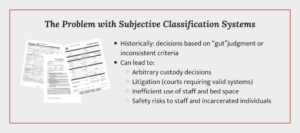
Over-classification deserves special attention. It can feel safer to classify upward. If someone might be a risk, place them in maximum custody. If there is uncertainty, err on the side of restriction. Over time, this approach results in a disproportionate number of individuals housed at higher custody levels than their institutional behavior warrants.
The unintended consequences are substantial:
- Concentration of high-risk individuals together
- Reduced access to incentives and programming
- Increased tension in housing units
- Higher staffing costs
- Greater reliance on restrictive housing
Another often overlooked consequence is the impact on individuals who would otherwise be lower risk. When lower-risk individuals are placed in highly restrictive or high-security environments, they are exposed to more serious offenders and more volatile housing conditions. Rather than stabilizing behavior, this environment can increase misconduct, reinforce negative peer influences, and undermine institutional order.
Research consistently shows that unnecessarily restrictive environments can escalate aggression and behavioral instability. In other words, placing someone at a higher custody level than appropriate can increase the very risks leaders are trying to reduce. In the long term, over-classification can actually make lower-risk individuals more difficult to manage, creating problems that did not previously exist.
Objective Classification: Structure, Not Elimination of Judgment
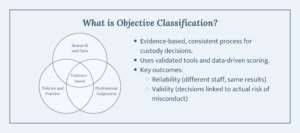
Objective classification is sometimes misunderstood as removing professional discretion. In reality, it does the opposite: it structures professional judgment within a validated framework.
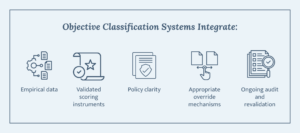
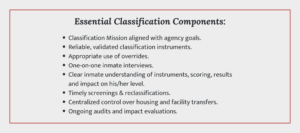
An objective classification system integrates:
- Empirical data
- Validated scoring instruments
- Policy clarity
- Appropriate override mechanisms
- Ongoing audit and revalidation
Objective classification answers two foundational questions:
- Reliability – Would two trained staff members reviewing the same individual reach the same custody recommendation?
- Validity – Does the custody level meaningfully predict institutional behavior, such as assaults or disciplinary infractions?
If a maximum-custody population does not exhibit higher rates of serious misconduct than a minimum-custody population, the instrument is not functioning as intended. Objective classification aligns custody decisions with measurable behavioral risk.
Initial Classification: Establishing Baseline Risk
Initial classification evaluates static factors – historical characteristics that cannot be changed through intervention. Common static factors include:
- Severity of current offense
- Prior criminal history
- History of escape
- Institutional violence history
- Age
- Gang affiliation
- Prior restrictive housing placement
These variables are not selected arbitrarily. They are tested statistically to determine their predictive relationship with misconduct within that specific jurisdiction.
It is critical to emphasize “within that specific jurisdiction.” No two correctional systems are identical. Population demographics, charge distributions, sentencing patterns, and facility design vary. A classification instrument validated in one state cannot simply be adopted wholesale in another without testing. Validation ensures the instrument is calibrated to local reality.
Reclassification: Behavior Drives Movement
Initial classification sets a baseline. Reclassification determines whether the system remains dynamic and behavior responsive. Reclassification instruments shift focus from static history to institutional behavior, including:
- Disciplinary reports
- Use-of-force involvement
- Program participation
- Work performance
- Recent institutional violence
This shift is operationally powerful. It reinforces a clear message: custody level is not permanent. It reflects behavior.
When individuals understand how their conduct directly influences their housing level, classification becomes more than a control mechanism – it becomes a behavioral management tool. This is often described as a “just desserts” model. Individuals move up or down based on measurable conduct. The system communicates expectations transparently.
Overrides: Preserving Professional Insight
Even the most rigorously validated instrument cannot capture every nuance of human behavior. That is why appropriate override mechanisms are essential. Overrides generally fall into two categories:
- Mandatory Overrides – dictated by statute or policy (for example, certain offense categories that restrict minimum placement).
- Discretionary Overrides – applied when professional judgment identifies risk factors not fully captured by scoring.
Importantly, overrides are not a failure of the instrument. They are a deliberate feature designed to ensure that staff expertise remains central to the classification process. Objective systems are not intended to place staff on autopilot; they provide a structured framework within which professional judgment can be applied thoughtfully and consistently.
The key is balance.
Override rates that are too low may indicate that staff are applying the instrument mechanically without thoughtful review. Override rates that are too high may signal that the instrument lacks credibility or is poorly calibrated. Healthy systems track override usage, analyze patterns, and adjust training or scoring accordingly.
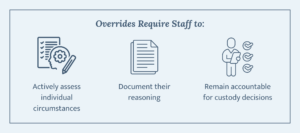
When used appropriately, overrides reinforce staff engagement in the classification process. They require staff to actively assess individual circumstances, document their reasoning, and remain accountable for custody decisions – strengthening both operational awareness and institutional safety.
Litigation and Defensibility
In serious incidents, one of the first legal questions asked is simple: “Where was the individual housed, and why?”
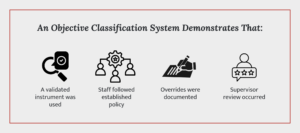
An objective classification system provides documented rationale. It demonstrates that:
- A validated instrument was used.
- Staff followed established policy.
- Overrides were documented.
- Supervisor review occurred.
This documentation does not eliminate risk, but it strengthens defensibility. It shows that decisions were structured, evidence-informed, and not arbitrary. In today’s correctional climate, where scrutiny is heightened and transparency expectations are increasing, this matters.
Technology Integration and Automation: Moving Beyond Paper
While classification instruments can function on paper, integration into agency data systems significantly improves sustainability. Automation, in this context, does not mean replacing staff decision making. It refers to embedding the classification instrument into an agency’s records management or jail management system so that certain data fields populate automatically and scoring calculations occur within the system.
Automating static variables such as age, offense severity, and criminal history reduces manual scoring errors and increases efficiency. When these elements pull directly from existing data fields, staff no longer need to manually look up or re-enter information that already exists in the system. This reduces scoring inconsistencies and allows staff to focus on the qualitative components of classification that require professional judgment.
Equally important, automated systems create structured data that can be easily extracted for analysis. When classification scores, overrides, and custody placements are stored electronically, agencies can evaluate how the instrument is performing over time. Analysts can examine whether higher custody scores are actually associated with misconduct, monitor override patterns, and identify areas where the instrument may require recalibration. This allows agencies to more easily extract data for periodic validation. Without automated or structured data capture, validation studies become significantly more difficult because historical classification decisions must be reconstructed from paper files, rather than analyzed directly from the system.
However, automation should not replace engagement. Best practice still includes direct interaction between classification staff and the individual being assessed. Explaining scoring outcomes, custody implications, and behavioral expectations reinforces transparency and procedural fairness. Classification is not just a numeric exercise. It is a communication process.
Revalidation: Why It Matters
Best practice recommends statistical revalidation approximately every five years. Why? Because correctional populations evolve. Sentencing patterns shift. Community supervision policies change. Behavioral trends fluctuate. An instrument validated a decade ago may no longer reflect current risk dynamics.
However, time alone should not be the only trigger for revalidation. Significant operational or policy changes can also alter the composition and behavior of a correctional population. Events such as sentencing reforms, bail policy changes, shifts in prosecution practices, expansion or reduction of diversion programs, or major facility operational changes can all affect who enters and remains in custody.
Large population fluctuations – including those experienced during the COVID-19 pandemic – can also meaningfully change the distribution of risk within a facility. When the makeup of the population changes, the statistical relationships that once predicted misconduct may weaken or shift. The revalidation process reassesses predictive variables, recalibrates cut points, and ensures continued reliability and validity.
Some jurisdictions maintain disciplined validation cycles. Others have not revisited their instruments in years. Given the pace of change in correctional populations, particularly in the post-pandemic environment, revalidation is not optional. It is a core risk management function.
Classification’s Broader Impact on Planning and Resource Allocation
Classification accuracy influences far more than housing assignments. It informs:
- Facility design
- Capital planning
- Staffing models
- Program space allocation
- Population forecasting
- Bed-type distribution
When classification systems inflate custody levels, agencies may overestimate the need for high-security housing and underestimate lower-custody programming space. Over time, this misalignment affects construction decisions and operating budgets.
Conversely, when classification is validated and properly calibrated, facility planning becomes more precise. Leaders can answer not just how many beds are needed, but what type of beds are needed.
That distinction is financially significant.
The Leadership Perspective
For correctional leaders, objective classification is not a technical exercise delegated solely to classification officers – it is a strategic lever. It influences safety, fiscal responsibility, staff morale, equity considerations, and long-term infrastructure planning.
When leaders prioritize validated, evidence-based classification, they establish a consistent framework that supports line staff decision making. Staff no longer rely solely on anecdotal experience or institutional habit. They operate within a structured, defensible system.
That consistency strengthens organizational confidence.
Returning to the Original Question
When a facility faces increasing incidents or capacity pressure, the instinct to expand maximum custody space is understandable. But before new construction begins, the more strategic inquiry remains: Are we confident that custody levels reflect validated risk?
If the answer is uncertain, the starting point is not more beds. It is examination of the classification system itself. Objective classification does not eliminate complexity. Corrections will always require professional judgment, adaptability, and operational vigilance. What it does provide is a stable foundation – a data-informed structure that aligns safety, fairness, and efficiency. And in today’s correctional environment, that foundation is indispensable.
Download the PDF
Meet the Authors