

The Justice Architect and The Beautiful Mind: Five Traits That Set Justice Architects Apart
Justice architects specialize in designing facilities for the criminal justice system, including courthouses, detention centers, juvenile facilities, and behavioral health units. These facilities of course differ from other facilities in that they require heightened awareness and focus on safety, security, rehabilitation, and human dignity (also referred to as “trauma-informed design”). Articles written about trauma-informed design typically focus on how the design affects those that work and reside in these facilities. This blog post instead focuses on the skills and capabilities unique to justice architects that allow them to serve as stewards of trauma-informed design.
Every justice architect I have spoken to utilizes five unique traits that allow them to think about, visualize, and understand a justice project inside and out. As someone who recently transitioned to justice architecture after 27 years in the private sector, I have a new heightened awareness of these traits. Working alongside and learning from highly experienced justice architects has helped me gain a better understanding of how they inform justice design when working with an experienced team. What I’ve come to realize is: these five unique traits are the common thread that defines us – and they build on one another.
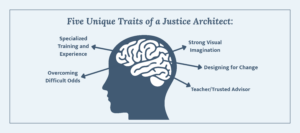
Five Unique Traits of a Justice Architect:
- Specialized Training and Experience – Understanding the mission
- Overcoming Difficult Odds – Cracking the hidden code
- Strong Visual Imagination – Seeing things that aren’t there
- Designing for Change – Changing people’s mindset
- Teacher/Trusted Advisor – Passing the knowledge along
Together, these traits are what allow a justice architect to take a very complex, ever-changing set of parameters and turn it into a physical building that serves people, budgets, and communities for decades. It’s an experience that’s extremely rewarding, humbling, and eye-opening all at the same time – and one worthy of strong consideration amongst those venturing into the profession of architecture. It all starts with the foundation every justice architect must establish first: the specialized training and experience needed to truly understand the mission.
Trait 1: Specialized Training and Experience in Justice Architecture – Understanding the Mission
The main mission of a justice architect is to use architecture as a tool for social change by designing spaces that address the physical, emotional, and social needs of the users. They aim to design not just for safety, but for dignity, restoration, and the long-term well-being of individuals and communities. Understanding this mission and delivering projects that meet it is not something one can achieve overnight; it takes years of additional training and experience to fully execute.
All architects must meet the minimum standards of qualification and registration as set forth by the profession’s governing board, the National Council of Architectural Registration Boards (NCARB). This process typically can take six to ten years (every architect has their own timeline and path on how they became registered) but becoming registered is only the starting line to becoming an experienced justice architect.
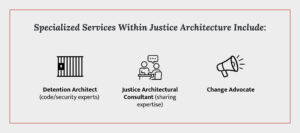
What sets justice architects apart is that they typically spend additional years undergoing specialized training to understand and implement justice-centered projects after they become certified. This knowledge allows them to provide not only architect of record services but other very specialized services within justice architecture that include (but are not limited to):
- Detention Architect (code/security experts): Possessing knowledge and understanding of all the specialized codes and regulations needed for justice architecture projects.
- Justice Architectural Consultant (sharing expertise): Serving as an owner’s representative or a trusted advisor by being knowledgeable about history as well as on the forefront of current trends of technology to inform current design.
- Change Advocate: Using knowledge and past experiences to advocate for equitable policies and practices, ensuring that design standards and built environments support justice reform goals well into the future.
Within the services they provide on any given project, the information justice architects must retain, file-away, analyze, and recall is extraordinary. Every justice project has a unique set of parameters or “code” that must be cracked for everything to come together. It’s the justice architect that uses their specialized training, experience, knowledge, and mind to crack this hidden code.
Trait 2: Overcoming Difficult Odds – Cracking the Hidden Code of Justice Facility Design

In the movie A Beautiful Mind (2001), John Nash, a mathematician played by Russell Crowe, has to decipher encrypted enemy telecommunications to identify hidden patterns in magazines and newspapers to thwart a Soviet plot.
One might say hiring a justice architect is very similar to the plot of A Beautiful Mind – they take all the complex data given to them, find the hidden patterns and connections, and create solutions – overcoming difficult odds to deliver a project that meets the client’s mission. This complex data comes in many forms, including projections, cost analyses, operational assessments, and FCA (Facility Conditions Assessment) reports, just to name a few. Justice architects must review and analyze all this data to help crack the code to inform the final design on every justice project
Like in the movie, there is a lot at stake if justice projects fail to meet their mission. Lives and jobs depend on justice architects cracking the code and delivering a project that meets the intended mission. When justice projects do fail, it’s often due to a combination of bad design, poor planning, and/or political/public backlash that interferes with the end goal.
When design priorities are misaligned, political or social contexts can also be ignored, budgets can be compromised, and stakeholder needs are not met. Success requires the justice architect’s mind to ensure ALL the data is used to inform the design. They must use their mind to visualize things others cannot and crack the code to deliver a product worthy of the client’s mission – failure is not an option.
Trait 3: Strong Visual Imagination – Seeing Things That Aren’t There
Architects spend a lot of time in thought, trying to visualize concepts before anything is put on paper. It’s typically within this state of thought that they start to have visions (seeing things that aren’t there). They must read between the lines, identifying connections within the complexity of the data to make informed decisions on the layout and physical properties of the building.
A justice architect’s mind has a heightened ability to visualize and decode unseen parameters or building functions that are never fully visible at the start of the project. These unseen parameters typically include (but are not limited to) the political, ethical, and social aspects that all justice projects need to maneuver through to help inform the physical design to ensure project priorities are not misaligned to the mission. Add on top of that the unseen programmatic elements like operational movement or designing to minimize operational costs, and the task at hand gets even further complicated.
So, how exactly do justice architects use their minds to decode the unseen and adapt the hidden parameters to inform the physical design of the building?
Decoding Public Opinion: The Political, Ethical, and Social Side of Justice Design
The political, ethical, and social aspects of a justice project typically are unknown at the beginning. These aspects require a high level of community engagement throughout the design process, to where these unseen parameters (the public opinion) come to light to help inform the physical design of the project. Sometimes, based on this community engagement, the justice architect must adapt, refocus, and/or change their thought process. They must ensure these unseen parameters are discussed with the stakeholders and included as part of the solution to the physical design to ensure the project reflects the community’s values and aligns with the mission.
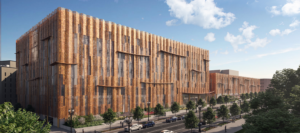
Pictured: The New DC Correctional Treatment Facility Annex is a great example of justice architecture responding to public opinion. Community engagement efforts revealed that some members of the public felt initial concept designs of the facility were too “harsh,” resulting in justice architects making adjustments to the design.
Visualizing the Unseen: Human Movement in Justice Facilities
Another example of seeing things that aren’t there relates to the concept of movement. How people interact with spaces to minimize unwanted movement of those occupying and working in these environments is critical to the success of a justice project.
They say, “time is money,” and over the lifespan of the building, which could be 40-50 years, minimizing unnecessary movement can save millions in operational costs, if done correctly. Moving occupants to and from court, programming, visitation or medical appointments must be visualized and planned to maximize efficiency.
The Justice Architect’s Visual Imagination at Work
In many ways, a justice architect’s mind never turns off, and a lot of clarity happens when the mind starts to visualize and influence an idea or the direction of a project. Within any given justice project, there are many justice experts involved. Each expert brings specialized abilities to help inform the design of the project, but it’s the mind of the justice architect that must read between the lines and take all the experts’ data, the community engagement outcomes, and the stakeholders’ requirements to budget, program, and start to visualize this information and put it all together. It’s within this visual imagination that architects typically have that “ah-ha” moment, where all the hidden parameters start to become visible and contribute to innovative ideas – ideas that not only inform current projects but help inform future projects and, in some cases, change the mindset for others to follow.
Trait 4: Designing for Change – Changing Mindsets Through Justice Reform
Over the past decade, there has been a clear shift in justice design to a more human-centric and rehabilitative approach. Not only does this shift offer new hope to change the lives of those occupying justice facilities, but it also signifies a new opportunity for justice architects to serve as advocates for change. Justice architects can now use their knowledge and past experiences to advocate for equitable policies and practices, ensuring that design standards and built environments support ongoing justice reform goals well into the future.
In 2022, the Department of Justice (DOJ) emphasized its ongoing commitment to justice reform with the release of its FY 2022-2026 Strategic Plan, outlining a strategy to strengthen the safety of our communities. The plan would advance thoughtful, evidence-based initiatives and reforms throughout the criminal justice system at the federal level, while supporting these goals at the state and local levels.
The DOJ’s strategic plan included these three main objectives:
- Safely Reducing Criminal Justice System Interactions – reduce the burden on law enforcement and strengthen public safety
- Supporting Rehabilitation During Incarceration – ensure meaningful opportunities for rehabilitation during incarceration
- Facilitating Reentry for People with Criminal Records – reducing recidivism
It takes a lot of collaboration between architects, community groups, corrections professionals, and other stakeholders to create spaces that reflect a wide range of needs to help support these justice reform initiatives. Justice architects must consider these needs and think about how they can help support the goals of justice reform.

A Human-Centric, Rehabilitative Approach to Correctional Facility Design
In the Correctional News article, “Designing for Change: Four justice architects weigh in on trends, challenges, and innovations shaping correctional facility design,” they discuss this clear shift that has happened over the last decade towards a more human-centric and rehabilitative approach to justice design. This approach prioritizes:
- Natural light
- Calming materials
- Spaces dedicated to mental health and substance abuse recovery programs
The article also discusses how technology has revolutionized justice with advanced systems enhancing security and enabling innovations like remote courtrooms, virtual visits, biometrics, and virtual monitoring. Technology will continue to advance, and justice architects will need to stay at the forefront to continue to provide human-centric and rehabilitative design.
This human-centric and rehabilitative approach isn’t just for the incarcerated. Staff wellness has become a critical focus. Facilities now include thoughtfully designed spaces to support those working in demanding, high-stress environments to support their mental and physical health and continued educational expectations. These changes help recruit and retain staff.
Designing Justice Facilities for Social Change
Justice architects can also make a strong impact on society through the development of facilities that foster positive social change for the incarcerated. A lot of progress has been made over the last ten years, with many states adopting justice reform strategies and a trauma-informed approach to new environments. However, it still takes time for true change to occur, and justice architects can really step up to help this effort by using their training and experiences to help challenge the status quo of the past and be the teacher/trusted advisor that takes us into the future.
Trait 5: Teacher and Trusted Advisor – Passing the Knowledge Along

Justice architects have two missions when it comes to passing along their knowledge. Their first mission is to serve as an advisor or strategic partner to their clients as part of the services they provide. Their second mission is to be a teacher to the next generation of justice architects for the next 40–50-year cycle.
As a trusted advisor, the justice architect’s role is to be an advocate for the owner throughout the project lifecycle – from planning and design through construction and closeout. This role is distinct from being a designer or contractor, allowing them to provide impartial oversight and strategic guidance to the project stakeholders to help them navigate all the twists and turns a project may face and make informed decisions. The experience and knowledge a justice architect brings to this role is recognized by the client early on in the project and helps ensure the project goals and mission are being met.
Core Responsibilities of a Trusted Advisor:
- Representing the owner’s interests
- Oversight and coordination
- Stakeholder management
- Problem solving
- Risk management
- Decision support
Justice architects deliver these responsibilities typically in the role of an owner’s representative. They help provide services such as review of design for constructability and completeness, and review schedules and budgets to guarantee compliance by acting as an extension of the owner’s team – ensuring the project is delivered on time, within budget, and aligned with the owner’s vision, while protecting their interests through impartial oversight and proactive management.
As a teacher, the responsibility of the justice architect shifts to his team.
Like jails, prisons, and courthouses, justice architects don’t get any younger. The total life cycle of a justice project is typically 40-50 years, while the professional lifespan of a justice architect is typically less than that. Justice architectural firms cannot continue to stay leaders in this profession unless they share their experience with the next generation. Justice architects are always looking for the next generation of highly skilled individuals that have the unique traits to overcome difficult odds, be able to adapt, design for change, and, in the end, be in position to share their knowledge and expertise with others.
Do You Possess the Beautiful Mind of a Justice Architect?

The combination of all these unique traits possessed by justice architects is exactly what separates them from other architects. The environments they create not only secure but also heal, empower, and transform individuals and communities. My hope is that this blog will inform a lot of people about justice architects – the traits and abilities they possess and the thought process that goes into every justice project.
If, as an architect, you feel you possess these traits, don’t be afraid to take the jump into justice! It’s a very important and rewarding role. As a justice architect, it is highly and personally gratifying to see positive change happen in the lives of all those that occupy the courthouses, detention centers, jails, juvenile facilities, and behavioral health units you help design.
Every justice architect has their own story about how they got to where they are today in their journey. I’m still writing mine and expanding on my expertise daily as a new justice architect for CGL, and I’m glad I have a team of experts here to help guide my journey and share their knowledge with me as I continue towards my goal to be part of the next wave of leaders in justice architecture for many years to come. I hope everyone has the opportunity one day to sit down with a justice architect to share stories and gain a better understanding of a justice architect’s mind.
Think you might have the mind of a justice architect? CGL is always looking for the next generation of talented professionals ready to make an impact through justice architecture. Explore what it’s like working at CGL and browse current openings. And if you’re planning a courthouse, detention, or correctional facility project, connect with our justice experts to experience firsthand the value a justice architect brings to your team.
Download the PDF
Meet the Author