
What Does a Courthouse Actually Cost? A Guide to Total Cost of Ownership
If you’re a county official planning a courthouse project right now, you’re doing it in a construction market where costs may have stabilized but remain elevated. You’ve probably been given a construction number. You may have seen a total project budget. But chances are, nobody has shown you what this building will actually cost your county over the next 30 to 50 years.
You’re not alone in that. A Government Accountability Office (GAO) review of federal courthouse projects found that actual construction costs exceeded design-phase estimates by an average of 17% and construction phases by 5%, and that value engineering decisions made to reduce construction budgets in some cases increased the long-term cost of operating the buildings.[1] These aren’t problems unique to the federal system. They’re the predictable result of planning around a construction budget instead of a Total Cost of Ownership Model.
My colleague Ed Whatley recently laid out the case for Total Cost of Ownership as the right financial framework for justice facilities. He made the point that construction is just the beginning. Everything after that is the life you have to fund. This article picks up where Ed left off and applies that framework specifically to courthouses, because courthouses carry financial complexities that you need to understand before you approve a budget, sign a contract, or break ground.
Why Courthouse Total Cost of Ownership Differs from Any Other Building
If you’ve been told what your courthouse will cost, you’ve probably been told a construction number. That number may be real, but it’s incomplete. A courthouse is not a commercial office building with a courtroom inside it. The differences are structural, operational, and financial, and they compound over the life of the facility.
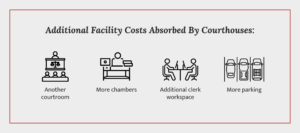
You’re paying for a building you don’t fully control. Judges, prosecutors, public defenders, clerks, and probation offices each operate under independent budget authority. You can’t set their headcount, their salary scales, or their growth plans. But when any of those agencies expand, you absorb the facility cost: another courtroom, more chambers, additional clerk workspace, more parking. A single courtroom costs more per square foot to build and equip than any room in a typical office building, and the decision to add one is often not yours to make.
In addition to that, dozens or hundreds of people who don’t work for you walk through your courthouse every day: jurors, witnesses, attorneys, defendants, families. That volume of public traffic accelerates wear on finishes, elevators, restrooms, and common areas at a rate that no office building experiences. Your parking situation is more complex than any commercial building you’ll ever manage (secure judicial parking, juror parking, public parking, law enforcement staging) at a structured parking construction rate that can cost $25,000 to $50,000 or more per space before you factor in its own maintenance lifecycle.
Beyond that, there’s the matter of public expectation. A courthouse is held to a standard an office building is not, and compromises in material or detail register with the people who use it.
Courthouse Construction Cost: The Tip of the Total Cost of Ownership Iceberg
Construction gets the most attention because it’s the largest single expenditure anyone will see during the project. But it’s worth understanding what that number actually represents in the context of what you’ll spend over the life of the building.
Most of the decisions that drive long-term cost are made during design, not during construction. Value engineering is standard practice on courthouse projects, and for good reason — it controls construction costs. But not every cut saves money in the long run. The GAO documented a federal courthouse where a window-washing platform was eliminated to save $250,000 during construction. That building subsequently had to spend approximately $30,000 per washing because special equipment had to be brought in — with the result that the windows were seldom washed.[2] That’s a decision that made the construction budget look better while quietly increasing operating costs for the life of the building.
The same dynamic applies to mechanical systems. A central utility plant may cost more to design and build than a set of rooftop packaged units. In a construction-only conversation, the rooftop units win. But central plants tend to be more energy efficient, last longer, and cost less to maintain over their lifecycle. In Forsyth County, a central plant shared between buildings resulted in nearly $20 million in cost savings over the life of the facility. If you select rooftop units to save money on the construction contract, you may end up paying significantly more in utility and maintenance costs over the next two decades.
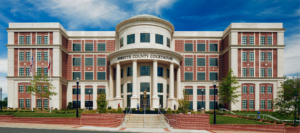
In Forsyth County, a central plant shared between buildings resulted in nearly $20 million in cost savings over the life of the facility.
And the bar keeps rising: security requirements, accessibility standards, and building codes all evolve over the life of a courthouse, and each change costs money. The person making today’s design decisions won’t be the one paying tomorrow’s operating bills. Sometimes, they may never meet. A Total Cost of Ownership model is designed to put them in the same room, looking at the same numbers, before those long-term decisions are final.
Why a Courthouse Uses More Energy Per Square Foot Than a Jail
You might assume a courthouse is relatively inexpensive to operate on the energy side because it closes at night. The data tells a different story.
The national median site energy use intensity for courthouses is 101.2 kBtu per square foot per year, according to EPA Energy Star data sourced from the Commercial Building Energy Consumption Survey (CBECS). For context, the median for correctional and detention facilities is 69.9 kBtu per square foot.[3] A courthouse, in other words, uses more energy per square foot than a jail, despite operating far fewer hours.
Courthouses also run above the commercial building stock generally. Analyzing 2012 CBECS data, researchers developing a Department of Energy prototype courthouse model found an average fuel consumption intensity of 94.7 kBtu per square foot, compared with 77.8 for offices and 80 for all commercial buildings combined.[4] While the authors recognized the gap to be modest and it didn’t represent a significant difference, it confirmed the direction that courthouses sit above commercial energy use intensity averages, and not in-line or below them.
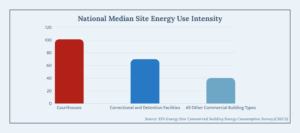
Part of the explanation is likely how courthouses concentrate energy-intensive activity into their footprint. Courtrooms run AV systems, evidence presentation displays, intensive lighting, and climate control in high-ceiling spaces with fluctuating occupancy. Server rooms, security screening equipment, and elevator systems add to the load. Design guidance compounds this: federal standards recommend splitting each courtroom into three separate HVAC zones (judge and attorney, jury, and spectators)[5] and require systems capable of operating well outside standard building hours. A detention center, by contrast, spreads its consumption across a larger footprint of housing units with more modest per-cell demands.
But regardless of the explanation, the data makes clear that you cannot assume your courthouse will be cheap to operate just because it powers down at night. The building system choices you make during design determine your energy costs for the next 15 to 20 years. Choose wrong, and you’re locked into those costs until the systems reach end of life.
Courthouse Operations and Maintenance Costs: Day One and Beyond
Your operating costs begin the day you move in and they never stop. Utilities, custodial services, facilities management, grounds maintenance: these are permanent budget lines that grow with inflation, with the age of the building, and with the demands placed on it.
Transition and Move-In Costs Most Courthouse Budgets Miss
Before those ongoing costs even begin, there’s the cost of getting into the building. Relocating active case files, evidence, and technology systems without disrupting court schedules. Purchasing furniture, fixtures, and equipment that weren’t part of the construction contract. Training staff on new building systems and courtroom technology. These transition costs are real and routinely left out of early project budgets.
The First Two Years: Commissioning and Warranty Management
The first one to two years after your courthouse opens matter more than most people realize. Building systems need to be commissioned, tested, and adjusted across a full cycle of seasons. This is also when the shortest warranties expire, while coverage on systems like roofing and curtain wall can run a decade or more. Keep in mind that warranties don’t maintain themselves: preventive maintenance is the owner’s responsibility from day one and continues indefinitely, and a warranty is only valid if the equipment has been operated and maintained in the intended manner.
If regular preventive maintenance per the manufacturer’s instructions is not performed and documented, it can invalidate the warranty for that system or piece of equipment. So you need a structured process that does two things: tracks each system’s warranty terms and expiration dates, and schedules and documents the preventive maintenance that keeps those warranties enforceable. Without it, you’ll lose the benefit of warranties you already paid for as part of the construction contract, and you’ll start seeing premature system issues that should have been caught and corrected under warranty.
Deferred Maintenance in a Courthouse is a Cost You Cannot Afford
Deferred maintenance is where the real damage happens. In an office building, deferred maintenance means peeling paint and a leaky roof. In a courthouse, it means water intrusion that damages records storage, HVAC failures that force courtroom closures, and security system gaps that compromise the safety of judges, staff, and the public. Every dollar you don’t spend on proactive maintenance comes back as multiple dollars in reactive repair.
It helps to be precise about three terms that often get used interchangeably:
- Preventive maintenance is the planned, routine work that keeps systems running as designed — the building equivalent of changing your car’s oil or rotating the tires.
- Lifecycle rplacement is the planned replacement of systems or components when they reach the end of their useful life — buying a new set of tires when the old ones are worn out.
- Deferred maintenance is what happens when you skip either one: the work doesn’t go away, it just waits, compounds, and gets more expensive.
Your major building systems (HVAC, roofing, elevators, fire suppression, generators) will each need lifecycle replacement at least once during the life of the building, some more than once. None of these are optional, and none are cheap. If you haven’t set aside money for them, they arrive as emergencies rather than planned projects… and emergencies always cost more — that’s deferred maintenance collecting its interest. These courthouse operations and maintenance costs don’t make headlines the way a construction budget does, but over the life of your building, they can easily exceed it. The construction number gets the vote. The operations number gets the bill.
Courthouse Staffing Costs: Your Building, Their People
Staffing is where courthouse Total Cost of Ownership diverges most sharply from any other building type your county will ever own.
Your courthouse doesn’t employ most of the people who work inside it. Your judges, prosecutors and public defenders operate under independent budgets. Your clerk’s office may be funded by the county, the state, or some combination. Probation may be entirely state-funded. Court administration staff may fall under the court system’s budget. Meanwhile, you built the building. You ensure that it is properly maintained, heated, cooled, and cleaned. But you don’t set the staffing levels or salary scales for the agencies that occupy it. You don’t decide when they hire or their positions get appropriated. You don’t decide when they grow. And when they do grow, the facility cost lands on you.
And conversely, the building itself drives staffing costs that compound over decades. A design that requires an extra security officer at a second screening station or additional deputies to cover an inefficient transport corridor isn’t just a staffing decision, it’s a financial commitment. A single $60,000 position, loaded with a conservative 40% fringe rate and 3% annual wage growth, costs your county more than $3 million over 25 years. Multiply that by every position your building forces you to add, and design choices that seemed minor during construction become some of the largest line items in your operating budget.
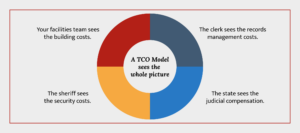
This fragmentation is what makes courthouse budgeting fundamentally different from anything else in your portfolio. No single budget authority sees the whole picture. Your facilities team sees the building costs. The sheriff sees the security costs. The state sees the judicial compensation. The clerk sees the records management costs. Each agency manages its own piece. Nobody is adding it all up… unless you build a Total Cost of Ownership model that does it for them.
Inmate Transport Costs: Why Courthouse Site Selection Matters
If your courthouse and your detention center aren’t on the same site (and in many jurisdictions, they aren’t) you’re running a daily security operation that rarely enters courthouse cost conversations. Every in-custody defendant requires transport: deputies, secure vehicles, fuel, and scheduling coordination, multiple times a day, every court day. The cost sits in the sheriff’s budget, but it’s driven entirely by court schedules the sheriff doesn’t control. Judges set dockets. Attorneys request hearings. The sheriff provides the security to make it happen.
This is why site selection matters beyond land price. The distance between your courthouse and detention center is a decision you make once and pay for every day for the life of the building. That daily cost should factor into site evaluation but usually doesn’t, because it doesn’t appear in the courthouse budget, it appears in the sheriff’s, and the two conversations don’t always connect.
Video arraignment can reduce some transport runs, but only for specific hearing types. Contested hearings, trials, and evidentiary proceedings still require physical presence. Remote technology shifts some cost, but it doesn’t eliminate it. A complete Total Cost of Ownership model captures transport as a cost driven by the courthouse’s existence, location, and operations, regardless of which budget line it falls under.
Long-Term Courthouse Costs: What Else Are You Missing?
Beyond day-to-day operations, several cost categories build over the life of the facility and are frequently underestimated or left out of early budget discussions.
Courtroom Technology: An Underestimated Cost
Technology is the most underestimated category. Evidence presentation systems, audio recording, video arraignment, and the network infrastructure beneath it all require significant upfront investment, and most courtroom AV systems need a full refresh within 7 to 10 years. Over a 50-year building life, that’s five or more complete replacement cycles. Without planned refresh budgets, the cost arrives as an emergency appropriation rather than a planned expenditure.
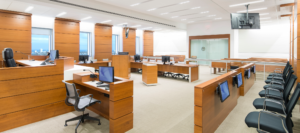
Pictured above: Broward County Courthouse AV system.
Record and Evidence Storage Costs
Records and evidence storage is shifting but not always shrinking. Paper files are declining but not disappearing, and electronic evidence (body camera footage, surveillance video, digital forensics) is growing steadily. Much of it may live on physical drives that can’t be wiped until retention requirements are met, and many jurisdictions are still working out the policies and systems for managing and disposing of it properly. The form factor is changing, but the obligation to retain, secure, and account for evidence doesn’t. When on-site storage falls short, off-site storage adds rent, security, and retrieval costs that compound over time.
Courthouse Funding and Financing: Bond Debt, Escalation, and the Cost of Waiting
Financing deserves as much scrutiny as the construction bid itself. Bond financing over 20 to 30 years can approach or exceed the original construction cost in total debt service, and the terms matter: a difference of a point and a half in interest rate can translate to tens of millions of dollars in total repayment. Without a full picture of long-term costs, financing decisions often default to delay.
This is a story that happens too often: traditional bond financing feels too costly, so the project waits. For a better rate, a better budget year, a better political moment. Three years pass, and construction costs don’t wait with you. The project that cost $150 million when the conversation started now costs $180 million or more, and the financing costs that felt too high turn out to be smaller than the escalation costs accumulated while avoiding them. Alternative delivery models (public-private partnerships), design-build-finance-operate, lease-purchase structures) exist precisely for this situation: spreading payments across the useful life of the facility, and in some cases transferring operational risk to a private partner. A Total Cost of Ownership model puts all of that on the table at once, so the true cost of every option (including waiting) is visible before the decision is made.
Why a Courthouse Can Be a More Complex Financial Commitment Than a Jail
If you manage both a courthouse and a detention center, your detention center is almost certainly the larger building, the heavier budget line, and the louder headache on any given day. It runs around the clock, houses a population that needs constant supervision and services, and its operating costs reflect that. But your courthouse is the more complex financial commitment. A detention center’s costs, as large as they are, mostly roll up to one budget authority: the county or the sheriff hires the staff, manages the operations, and pays the bills.
Your courthouse doesn’t work that way. Its costs are fragmented across independent agencies with independent funding streams, independent growth trajectories, and independent decision-making authority. Most of what drives demand on a courthouse — judgeships, attorney staffing, records retention — is set by statute, rule, or appropriation rather than by the county that owns the building.
Building the Case for a Total Cost of Ownership Model
This cost fragmentation is exactly why a Total Cost of Ownership model matters more for a courthouse than almost any other building your county will ever own. It’s the only tool that puts all those costs (construction debt, daily operations, security staffing, technology refresh, records storage, transport) in one balance sheet where you can see them, plan for them, and explain them to the people who approve the funding. Nobody else is going to add it all up for you.
References:
- S. Government Accountability Office. (2005). Courthouse construction: Information on project cost and size changes would help to enhance oversight (GAO-05-673). https://www.gao.gov/products/gao-05-673
- S. Government Accountability Office. (2005). Courthouse construction: Information on project cost and size changes would help to enhance oversight (GAO-05-673). https://www.gao.gov/products/gao-05-673
- S. Environmental Protection Agency. (2024). U.S. energy use intensity by property type [ENERGY STAR Portfolio Manager technical reference]. https://portfoliomanager.energystar.gov/pdf/reference/US%20National%20Median%20Table.pdf
- Malhotra, M., Im, P., & New, J. (2019). A process for defining prototype building models: Courthouse case study for U.S. commercial energy. Energies, 12(20), Article 4020. https://doi.org/10.3390/en12204020
- Judicial Conference of the United States. (2007). S. courts design guide. Administrative Office of the U.S. Courts, Space and Facilities Division.
Download the PDF
Meet the Author