
Opening a New Correctional Facility: The Maintenance Manager’s Perspective on Commissioning and Year-One Operations
Opening a new correctional facility is more than turning over keys and bringing a building online; it is the start of a partnership, a learning process, and a commitment to supporting a safe and secure environment. I learned this firsthand earlier on in my career while serving as the building and grounds superintendent at the 1,050-bed Green Rock Correctional Center in Chatham, Virginia for the Virginia Department of Corrections, where I was responsible for all aspects of maintenance.
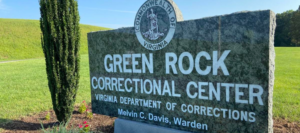
Green Rock Correctional Center represented an important step for both the Virginia Department of Corrections and our facility maintenance division, bringing together facility leadership, security staff, contractors, and maintenance professionals to prepare a complex operation for daily use. Looking back, the experience showed me how critical strong communication, teamwork, and dependable maintenance are to the successful opening and long-term operation of a correctional facility.
Starting a New Chapter: VADOC’s First Outsourced Correctional Maintenance Program
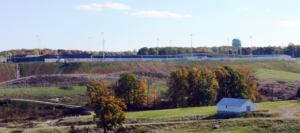
Pictured: Green Rock Correctional Center (Chatham, Virginia)
In March 2007, I was fortunate to be hired by CGL as the first facility maintenance manager at the new Green Rock Correctional Center for the Virginia Department of Corrections (VADOC). At that time, VADOC and CGL had agreed to use outsourced maintenance services for the first time at one of its facilities. That decision carried real weight.
Outsourcing the maintenance of a correctional facility is a major organizational shift – one that touches operations, workflows, budgets, and even the culture surrounding how a facility is cared for. There are several key factors to a smooth transition to an outsourced maintenance model, and many of those factors – proactive leadership, early stakeholder engagement, and a dedicated start-up team – were exactly what we lived out at Green Rock, years before anyone had written them down. As the first facility of its kind for VADOC, we knew we were not just maintaining a building; we were demonstrating what an outsourced maintenance partnership could look like for an entire state correctional system.
One of the greatest advantages of opening a new facility was being involved from the beginning. We worked directly with the people who built the facility, which allowed us to ask questions and usually receive quick answers. Looking back, several key phases shaped the start-up process and helped me understand how correctional facility maintenance truly works.
Phase 1: Building Relationships with Security Staff and Facility Leadership
The first phase was meeting and working with the new security staff, beginning with the warden and his leadership team. Building strong relationships with security staff was essential to starting off on the right foot. Expectations were clearly communicated, and open communication was critical because we were all beginning a new journey together.
What Makes Correctional Facility Maintenance Different
I quickly learned that opening a new correctional facility was far different from working in industrial maintenance, especially while operating under the policies that govern preventive and corrective maintenance in a major correctional setting. Although my background was in industrial electrical maintenance and supervision, with additional experience in plumbing, welding, and electronics, I also learned a great deal from the skilled craftsmen hired alongside me.
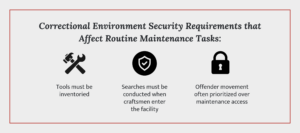
My staff and I were required to complete training on the policies necessary to perform our duties safely and efficiently. This training covered many aspects of working around inmates, including key control, tool control, working in a correctional environment, and other procedures unique to corrections. Many routine maintenance tasks differed due to security requirements designed to reduce vandalism and maintain safety. In the commercial industry, a technician might simply gather tools and go to work. In corrections, tools had to be inventoried, security conducted searches each time craftsmen entered the facility, and offender movement often took priority over maintenance access. Patience quickly became an essential part of daily operations.
What I came to appreciate over time is that these procedures are not obstacles to the work – they are the work. In a correctional environment, safety and maintenance operations cannot be treated as competing priorities; they have to reinforce one another. That mindset has to be built from day one, through briefings, training, and daily habits, until following secure work practices becomes simply “the way we do things.” This is what we describe as building a true safety culture within a facility maintenance organization, and Green Rock is where I first saw that culture take root, one toolbox inventory and one security briefing at a time.
Commissioning the Facility: Standing Up the CMMS and Capturing Warranty Data
During this period, we also trained in the new Computerized Maintenance Management System (CMMS). The maintenance department was responsible for entering all facility assets, creating preventive maintenance schedules, learning how to create and assign work orders, entering comments and labor time, and closing work orders once repairs were completed. We also entered data for warranties that were on the newly installed equipment, the vendor, and additional preventive maintenance schedules and requirements that may not have been brought up or required. We learned very quickly that just because it was new, everything was not going to work flawlessly or as intended. Adjustments would have to be made as we opened.
That early investment in data paid for itself many times over. If a piece of new equipment failed in those first months, we could pull up the asset record, confirm the warranty terms, and get the manufacturer or installing contractor to make it right at no cost to the Commonwealth. Without that documentation, those repairs may have become the facility’s expense. A CMMS is only as good as the information entered into it, and the opening of a facility is a one-time opportunity to build that foundation correctly, while the equipment is new, the manuals are in hand, and the people who installed everything are still on site.
Phase 2: Working Alongside the Contractors Who Built the Facility
Another important phase was working alongside the contractors who built the facility. We attended meetings, received operation and maintenance manuals for the new equipment, and created training videos on systems such as the generators and PLC-controlled boards. Before offenders arrived, we were able to see how the facility was assembled and how the systems operated, which was a major benefit.
This is a lesson I would offer to any agency planning a new facility: get your maintenance team on site as early as possible. We have long advocated for involving maintenance professionals early in the design and construction process, because the people who will care for a building for the next 30 years see things designers and builders cannot. Every question we asked a contractor before opening day was a work order we did not have to figure out alone afterward. Transitioning into a new facility is far more than coordinating a move – it requires aligning operations, systems testing, and training long before opening day.
Phase 3: Building the New Maintenance Team
The final key part of the start-up was building the new maintenance team. It was important to understand the skills each person brought to the table. Most staff members had talents beyond their specific trade, and everyone helped one another learn different crafts. This teamwork allowed us to complete special projects that arose during the opening.
The experience and dedication of the maintenance staff made the start-up much smoother. The craftsmen were outstanding, and each of them wanted Green Rock to succeed and serve as a strong example of what CGL could provide for VADOC. I believe that has been proven over the years. Since Green Rock opened, CGL has gained opportunities to support additional facilities because of the success, hard work, and commitment demonstrated there every day.
Year-One Operations: What the First Twelve Months Really Look Like
Commissioning ends, but the learning does not. Once the facility was occupied, the building came alive in ways no walkthrough could predict. Systems that had only run under test conditions were suddenly operating under full load – kitchens serving over a thousand meals a day, showers and plumbing fixtures in constant use, and HVAC systems responding to a fully occupied building for the first time.
The first year is really four seasons of discovery. The first summer tells you how the cooling systems truly perform under peak demand; the first winter tests the boilers and heating systems in ways no acceptance test can. Each season, we adjusted preventive maintenance schedules in the CMMS based on actual equipment run times and conditions rather than manufacturer assumptions.
Year one is also when a maintenance team earns its credibility. Every work order completed promptly, every emergency handled without disrupting facility operations, and every honest conversation with the warden’s team about what we found and what we fixed built the trust that made the partnership work. In a correctional facility, security staff need to know that when maintenance says something will be handled, it will be – because a broken lock, a failed camera, or a down generator is never just a maintenance issue. It is a security issue.
Why Preventive Maintenance from Day One Protects the Investment
A brand-new facility can create a false sense of security. Everything works, everything is under warranty, and it is tempting for an agency to treat maintenance as a problem for later. In reality, the opening of a facility is the single best opportunity to establish a preventive maintenance program, because the practices set in year one determine whether that building ages gracefully or prematurely.
The financial case is compelling. Drawing on an independent Whitestone Research study of criminal justice facilities, it was found that providing preventive maintenance saves more than $13 per square foot over 10 years and more than $25 per square foot over 20 years compared to deferring it – savings that can reach millions of dollars over a facility’s life. Construction is only the down payment on a correctional facility; operations and maintenance represent the far larger share of its total cost of ownership over 30 to 50 years of service. At Green Rock, building the preventive maintenance schedules into the CMMS before the first offender arrived helped prevent the deferred maintenance backlog that burdens so many aging institutions.
Key Takeaways for Opening a New Correctional Facility
- Opening a correctional facility requires strong coordination among maintenance, security, leadership, contractors, and facility staff.
- Clear communication and relationship-building are essential to creating a safe, secure, and efficient operating environment.
- Correctional maintenance requires patience, planning, and a strong understanding of security procedures such as key control, tool control, and inmate movement.
- Early involvement with contractors and facility systems provides valuable knowledge that supports long-term maintenance success.
- Accurate asset, warranty, and preventive maintenance data entered into the CMMS during commissioning pays dividends throughout the life of the facility.
- Preventive maintenance from day one protects the taxpayer investment and prevents the deferred maintenance backlog that burdens many aging facilities.
- A skilled, flexible, and committed maintenance team is critical to solving problems and supporting the facility’s mission.
- Green Rock demonstrated how preparation, teamwork, and partnership can create a strong foundation for future success.
Green Rock’s Lasting Impact
Over time, Green Rock has proven to be more than just a new facility opening; it has become an example of how preparation, teamwork, and strong partnerships can create lasting success. The lessons learned during those early days helped shape how outsourced maintenance services could support a secure, efficient, and well-operated correctional environment. Green Rock demonstrated the value of a dedicated maintenance team working closely with facility leadership and security staff to solve problems, protect critical systems, and support VADOC’s overall mission. For me, being part of that beginning remains one of the most meaningful experiences of my career.
Download the PDF
Meet the Author