
IT Integration in Criminal Justice Capital Programs: A Strategic Imperative for the New Reality
Why IT Integration Is Critical to Criminal Justice Facility Planning
Delivering modern criminal justice facilities requires more than strong design and construction management. It demands a fully integrated partnership between client IT leadership and program management teams from the earliest planning stages through activation and occupancy.
Successful program delivery depends on practical, cross-functional guidance at every step, from planning through the transition to occupancy. Agencies should consistently review program outcomes to identify emergent issues and risks that may impact future capital programs, and proactively apply these lessons learned to the benefit of the agency and its stakeholders.
For more than 30 years, I’ve worked to improve detention, correctional, and courthouse environments – and this experience consistently shows that IT systems now carry the same criticality as life safety, security, and power infrastructure. As technology complexity accelerates, successful program delivery depends on embedding IT strategy, governance, and expertise directly into the capital program structure.
The successful delivery of criminal justice facility programs requires a fundamental shift towards a strategic partnership between client IT organizations and capital facility program management teams. Client IT leadership and expertise should be more deeply integrated within the program management team throughout the project and facility life cycle.
Client IT Organizations and the Emerging New Reality
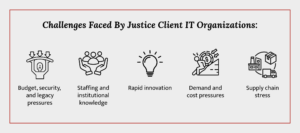
Today’s justice client IT organizations are challenged on multiple fronts:
- Budget, security, and legacy pressures: budget constraints, increasing security risks, and aging legacy infrastructure.
- Staffing and institutional knowledge: Artificial Intelligence (AI) investments are challenging clients’ ability to retain staff with institutional knowledge and deep expertise.
- Rapid innovation: Client organizations are also challenged to keep pace with innovations in criminal justice systems and equipment – such as AI-enabled surveillance systems, autonomous guided vehicles and robotic workers.
- Demand and cost pressures: AI investments are also driving external demand for systems and equipment – placing additional pressures on budgeting and cost management.
- Supply chain stress: Supply chains are stressed – impacting suppliers’ and vendors’ ability to deliver solutions on target for quality, cost, and schedule.
While client IT agencies are increasingly challenged by a multitude of factors, their efforts should not be further confounded by a program management team that lacks an enhanced strategy, plan, and resources to support their success on major capital programs. The program team must reduce—not add to—the burden on IT.
Major Capital Program Delivery Challenges
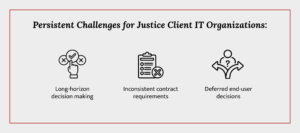
Major capital programs generally require many years to plan, fund, design, and construct. This creates three persistent challenges for justice client IT organizations:
- Long-horizon decision making: A challenging role for any operational IT entity is to shift its focus from issues that require day-to-day and immediate response and instead address issues and make decisions – for the long term – many months and years in advance of their delivery.
- Inconsistent contract requirements: Construction contracts are ultimately very detailed and can sometimes inconsistently address IT-related issues if the roles and responsibilities for IT solution delivery are not clearly defined and consistently applied throughout the project lifecycle.
- Deferred end-user decisions: Many end-user organizations defer and delay important decisions on systems and equipment that can result in changes to infrastructure work already completed.
Until recently, IT integration could generally rely on reasonable approaches and assumptions, with coordination issues resolved quickly and affordably. Today’s new reality requires a new approach. Current planning for future projects must address the increasing variety, complexity, number and extent of systems that require integration with complex client IT environments and the increasing intricacy of their delivery and activation.
Recommendations for Full IT Integration in Criminal Justice Capital Programs
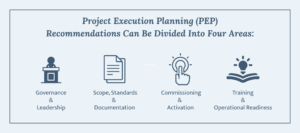
Project Execution Planning (PEP) frameworks are readily available to program management teams and client organizations. We strongly recommend inclusion of the following recommendations into the PEP for your project, whether it is at a starting point or your project is underway. These recommendations should be scaled in response to the size and complexity of the program, and they fall into four areas: governance and leadership; scope, standards, and documentation; commissioning and activation; and training and operational readiness.
Governance & Leadership
- Include IT leadership on the project steering committee. Include client IT leadership in project steering committee meetings responsible for overseeing project development and performance. Encourage IT leadership to be accountable for consistent active engagement in the steering committee process throughout the full program duration.
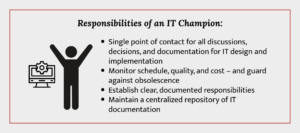
- Appoint an IT Champion. Identify an IT Champion – preferably a qualified third-party consultant reporting to the Owner or the program manager to act as the single point of contact / clearinghouse for all discussions, decisions, and documentation for IT design and implementation.
Scope, Standards & Documentation
- Monitor schedule, quality, and cost – and guard against obsolescence. The IT Champion is responsible for monitoring schedule, quality, and cost – and with respect to schedule specifically, the IT Champion should periodically review project scope to ensure it is aligned with current best practices and mitigates end-of-life risk for system obsolescence. With respect to scope management, the IT Champion must set limits for end-user change requests and ensure end users fully understand the functionality of the systems being provided.
- Establish clear, documented responsibilities. The IT Champion shall ensure a shared, documented understanding of who is responsible for any given aspect for the design, procurement, installation, testing, and certification process for any system and its components. Confirm the work limits performed by designers and builders as compared to work the IT team will deliver with their suppliers and vendors. Recommend that any work performed by the IT team suppliers be carefully documented and coordinated with base building drawings and specifications.
- Maintain a centralized repository of IT documentation. The IT Champion shall maintain the repository of record documentation for reference by other members of the program team, client leadership, end users, and stakeholders. This repository is to ultimately house project turnover documentation relative to IT systems integrated within the new facility.
- Develop an IT Master Plan. Ensure development of an IT Master Plan to outline all needed networks, systems, and components. Include protocols for security, chain of custody, and confidentiality.
- Evaluate existing IT systems early. Secure an evaluation of existing client IT networks, systems, and components that are relevant to or may be impacted by the planned project scope.
- Elevate IT to a critical infrastructure discipline. Embed IT requirements into the program from the start—elevate and recognize IT as a critical system akin in importance to electrical power, life safety, and primary HVAC systems.
- Confirm client IT standards. Confirm client IT standards for network design, procurement, and operation, so that the design team has insight into client IT practices. There should be no surprises with respect to existing systems or standards for new work as the program team proceeds to plan and design the new facility.
- Define power classifications clearly. Ensure power requirements are clearly understood – whether loads are classified as life safety, critical, emergency or otherwise. There should be no ambiguity as to the extent of back-up redundant power sources – with or without facility Uninterrupted Power Supply (UPS) protection.
Commissioning & Activation
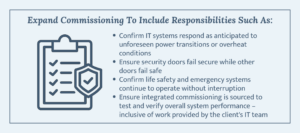
- Expand commissioning to include full IT system performance testing. Expand the scope of traditional facility commissioning to include IT systems – confirm IT systems respond as anticipated to unforeseen power transitions or overheat conditions. Ensure security doors fail secure while other doors fail safe. Confirm life safety and emergency systems continue to operate without interruption. Ensure integrated commissioning is sourced to test and verify overall system performance – inclusive of work provided by the client’s IT team.
- Require commissioning data that works with your facility systems. Ensure the commissioning team provides data suitable for download into client building automation systems and computerized maintenance management systems.
Training & Operational Readiness
- Train end users thoroughly before occupancy. Ensure end users are thoroughly trained in the operation of new systems prior to their use. Perform mock emergency events to raise awareness and understanding of system use under duress.
- Ensure alarm logic, notification pathways, and escalation protocols are understood. Ensure client organizations have a complete understanding of various alarm events, how they trigger responses, and how they communicate notification to stakeholders – inclusive of IT leadership.
Case Studies: IT Integration Successes in Justice Facilities
It’s always important to apply lessons learned and to review and analyze ‘things-gone-right’ to identify the underlying patterns and factors that contributed to their success. Two recent projects illustrate the value of early IT integration and disciplined coordination. The first example is a recent courthouse project, which involved the successful implementation of a robust judicial audio-visual system. The second is from a recent mission-critical facility activation that required supplementary commissioning efforts for critical facility communications infrastructure in response to normal power loss.
1. Judicial Audio-Visual System Installation and Integration

At a glance: A courthouse project successfully deployed a robust judicial AV system across courtrooms, jury rooms, and detention units. Clear documentation, proactive IT engagement, and well-organized end user input enabled precise infrastructure coordination and minimal post-completion changes.
This installation includes systems and technologies integrated within multiple Courtrooms, Video Arraignment and Jury Rooms. Video-arraignment systems located in detention units are utilized to minimize movement of inmates to Courtrooms. Remote monitoring and control rooms allow Court staff to oversee system performance. The program management team engaged an experienced provider for this system, and the end user group was particularly well organized with their inputs for system requirements. The team also included a proactive IT group focused specifically on Court network facilities. Design sessions were carefully documented and the detailed facility design coordination reviews ensured installation of infrastructure elements to support the overall system. Changes made post substantial completion were minimal and readily accommodated in allowances set aside for this purpose. Today, the Courts utilize a robust system that is efficient, ensures confidentiality and is isolated from all other networked communication systems in the complex.
Successful implementation of this system relied upon clear communications and roles among project participants. End users collaborated with the program team and the IT SMEs to define and document a solution. Minor modifications made at the end of implementation responded to advances made in the technology and given the economy / efficiency of the overall installation, there were contingency funds available to step up the ladder of new system capability.
2. Power Transition Testing to Confirm Critical Communications Functionality

At a glance: A mission-critical 911 dispatch center required additional functional testing beyond base building commissioning to validate communications system performance during power loss. A cross-functional team rapidly developed and executed test procedures, identifying minor issues and confirming system resilience – without cost or schedule impacts.
Recent activation of critical communication systems supporting a major 911 dispatch facility required a proactive approach to confirm integrated system performance in the event of normal power loss. Base building commissioning demonstrated conformance of redundant electrical power system performance with design requirements but did not include any functional performance testing that measured the response of critical communications systems – including loss of power to UPSs feeding power panels supporting critical communication servers and terminal equipment.
The program management team worked with a cross functional team of end users, IT leads, design engineers, and construction contractors to define functional test procedures. The team implemented a series of carefully planned test procedures and identified a short list of items for further review or correction. The outcome of the process was a shared sense of certainty that the center would successfully navigate through future unforeseen interruptions to normal utility power.
The team recognized a shortcoming in the scope of base building commissioning and took steps to confirm suitability of the completed facility system – inclusive of critical communications systems. Although the need for this testing was not identified early in the process, the team quickly mobilized and performed the needed testing with no cost or time delays. The engineers brought forward careful, detailed documentation of the functional performance tests, and they were completed well within the time frames set aside for the task.
These two examples demonstrate how the Owner’s Representative and/or program management team must work closely with the justice client’s IT leadership, end users, and suppliers to deliver IT systems that are completely integrated with project delivery and ready for transition to occupancy.
Lessons Learned: What Happens When IT Integration in Criminal Justice Facilities Falls Short
To provide a more tangible grasp of the importance of this topic, let’s look back at recent project outcomes that impacted readiness – delaying startup or confounding operations at mission-critical criminal justice facilities. Each outcome highlights the risks of insufficient IT integration. Consider the following:
1. Security system performance failures due to undersized infrastructure
Post occupancy modifications to security systems were needed to correct slow performance due to poorly-scaled infrastructure elements; system deficiencies resulted from a supplier’s poorly-informed understanding of the client usage requirements – the performance of the system was quickly overwhelmed and modifications to increase system capacity and performance to meet specification were required.
This circumstance developed largely due to a breakdown in communications between the installing contractor, program team, and IT experts – had there been a more robust dialogue amongst the participants, this unfortunate outcome could have been prevented.
2. Reliance on end-of-life IT components with known security vulnerabilities
Continued reliance on end-of-life IT infrastructure components, with known security risks, was needed to allow facility start up to proceed on schedule. IT teams may or may not have full control over the breadth of systems under their care and it is not uncommon for older systems to have been procured and installed without knowledge of the IT organization. When these conditions are uncovered late in the project delivery, this may result in delayed system installations or continued reliance on systems that lack appropriate security profiles.
The end-of-life status of the existing IT system was not understood early enough in the process to allow for its replacement with a cloud-based solution that met the client’s IT security protocols. The client had to make a difficult choice between maintaining schedule and extending some level of security risk into the future. A more proactive approach to reviewing the status of existing systems – a responsibility that would fall to the IT Champion – could have resolved this issue well in advance of day one activation.
3. Delayed readiness of secure housing units caused by third-party installations
Rework and delay to readiness of secure housing units resulted from deferred third party installation of systems and equipment – impacting accepted secure construction – resulting in redundant shakedowns and inspections prior to secure occupancy. The decision to export responsibility for work in secure areas following turnover to the client organization seems simple enough until that third party installing contractor brings in labor, tools, and equipment to modify aspects of the housing unit construction – resulting in a redundant shakedown process to ensure no tools or equipment are left behind.
This unfortunate outcome could have been addressed with a more strategic review of roles and responsibilities and the decisions taken to assign certain scope responsibilities to the prime contractor. Based on this experience, it’s strongly recommended that the prime contractor be responsible for delivering a turnkey secure environment – ready for operation and use on day one.
4. Late-stage end user change requests
Multiple late-stage end user change requests to modify system functionality and footprint resulted in delayed readiness and multiple change orders to suppliers and vendors.
Some of this is simply unavoidable. However, much of this late change can be avoided by the interactions between the users and the IT Champion utilizing 3D images of the space and talking through the intended functionality of the system design so that any critical changes can be managed well in advance of completion.
Each of the impacts listed above carries a cost – to schedule, budget or security – that could have been mitigated or reduced by the recommended approaches outlined in this post.
Early IT Integration Is No Longer Optional
The recommendations in this post respond to real-world experiences in this rapidly changing environment, and we strongly encourage implementation of these recommendations on your next major capital program. The risks within criminal justice facilities, particularly detention and correctional facilities, are considerable.
Ideally, the IT governance team and program management IT Champion are engaged early in the project-shaping process and have influence on the overall PEP. This early engagement, followed by ongoing consistent leadership for technology integration, is no longer an optional approach. It is a prudent investment in best ensuring comprehensive facility readiness at turnover to use, followed by consistent operating performance going forward into the full duration of the asset life cycle.
Download the PDF
Meet the Author