Seven Keys to a Smooth Transition to an Outsourced Maintenance Model
Outsourcing the maintenance of a justice facility or county-wide campus is a major organizational shift – one that affects operations, workflows, budgets, staffing models, and even the culture surrounding facility stewardship. But when done with foresight and collaboration, outsourcing can produce a more reliable maintenance program, reduce long-term costs, and create safer, better-performing environments for staff, visitors, and occupants.
This guide outlines seven essential components for ensuring a smooth transition from an internal or hybrid maintenance approach to a fully outsourced model. These steps reflect long-standing best practices in maintenance Each step focuses on what agencies, counties, and facility leaders should understand and expect when transitioning to an outsourced partner – whether they oversee a single courthouse or a network of detention, administrative, and public-safety buildings.
Key 1: Proactive Leadership
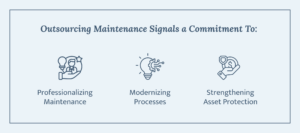
A successful transition starts – and often succeeds or fails – with leadership’s ability to champion the shift. Outsourcing maintenance represents more than a contract change. It signals a commitment to professionalizing maintenance, modernizing processes, and strengthening asset protection. Leaders who articulate this vision clearly lay the groundwork for trust, stability, and adoption.
Why Proactive Leadership Matters
Getting off on the right foot requires thoughtful communication, early alignment, and accessible decision-making. This is where proactive leaders come in.
Leadership involvement helps:
- Set expectations for performance, transparency, and reporting.
- Communicate the purpose, benefits, and goals of outsourcing to staff across the organization.
- Reinforce that maintenance is a mission-critical function, not an afterthought.
- Encourage staff buy-in by addressing concerns early.
More importantly, proactive leaders help create clarity around what the transition must accomplish—whether it’s reducing deferred maintenance, strengthening preventive maintenance, managing risk, improving compliance, or stabilizing labor challenges.
What Proactive Leadership Looks Like
- Holding early briefings with internal maintenance personnel.
- Establishing guiding principles for the transition (e.g., continuity, safety, asset longevity, customer service).
- Engaging stakeholders such as procurement, finance, risk management, and facility users.
- Helping facilitate introductions and communication pathways with the incoming maintenance provider.
Leaders set the tone. Their visible support reduces uncertainty, signals respect for facility staff, and ensures the outsourced program starts on solid ground.
Key 2: Early Engagement with Agency & Facility Stakeholders
Outsourcing will affect nearly every stakeholder who interacts with your buildings – from frontline officers and court staff to IT and capital planning. Engaging them early is essential to developing a clear picture of maintenance needs, expectations, and existing pain points.
It’s important to emphasize just how vital early communication is to ensure a seamless transition. Thorough dialogue allows the new provider to:
- Understand each facility’s mission, critical systems, and operational constraints.
- Identify areas where maintenance workflow improvements will benefit end users.
- Develop service levels that align with how your facilities operate day-to-day.
- Clarify response-time expectations, access procedures, safety protocols, and communication channels.
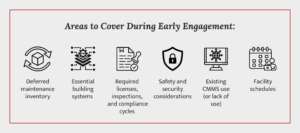
Areas to Cover During Early Engagement
- Deferred maintenance inventory
- Essential building systems and known issues
- Required licenses, inspections, and compliance cycles
- Safety and security considerations, especially in justice environments
- Existing CMMS use (or lack of use)
- Facility schedules – the “rhythms” of courtrooms, housing units, intake, etc.
The goal is not merely to hand over a contract – it is to co-create a maintenance program that works for the people who rely on the facilities every day.
Benefits of Early Engagement
- Smoother onboarding and reduced disruption
- More accurate staffing and skills assessment
- A maintenance strategy aligned with each facility’s unique operational needs
- Higher satisfaction from internal teams who feel heard and involved
When done successfully, careful early engagement results in a customized approach, which is Key 3.
Key 3: A Customized Approach for Every Facility or Campus
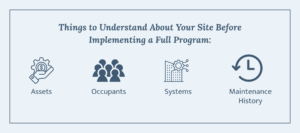
No two facilities are alike. Each courthouse, detention center, administrative building, or public-safety campus has its own age, design nuances, operational realities, and risk profile. It’s hard to understate the importance of developing a comprehensive understanding of each site’s assets, occupants, systems, and maintenance history before implementing a full program.
Why Customization Is Essential
A maintenance strategy that works for an administrative office might be insufficient for a high-security detention space. Likewise, a modern courthouse with advanced technology systems requires different care than a decades-old facility with inconsistent mechanical performance.
A customized approach ensures the outsourced provider:
- Establishes the right staffing levels and craft trades for each facility.
- Develops maintenance procedures and operations manuals aligned with your buildings.
- Understands compliance obligations (e.g., NFPA standards, state or federal jail standards, inspection frequencies).
- Builds preventive and corrective maintenance plans based on data, not assumptions.
- Identifies critical spare parts, known issues, and system vulnerabilities.
What a Customized Approach Includes
- Facility Conditions Assessments to pinpoint lifecycle needs and risks
- System inventories (HVAC, electrical, security electronics, life-safety, etc.)
- Site-specific preventive maintenance plans
- Clear protocols for emergency response and after-hours work
- Integration of existing CMMS or implementation of a new CMMS
- Energy management considerations
- Subcontractor requirements, especially for specialty systems
This level of customization builds a stable foundation for the maintenance program and reinforces trust among facility users.
Key 4: A Dedicated Start-Up Team
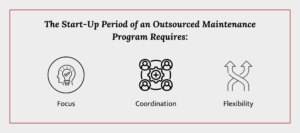
One of the strongest predictors of success is assigning a dedicated start-up team whose primary role is to support the transition. The start-up period is one of the most intense phases of an outsourced maintenance program. It requires focus, coordination, and flexibility.
Why a Dedicated Start-Up Team Works
A focused team helps ensure:
- A seamless transition from incumbent services
- Clear communication with facility stakeholders
- Rapid development of maintenance manuals and procedures
- Accurate asset inventory and data capture
- Immediate responsiveness to early needs and issues
- Consistent interpretation of service expectations across all facilities
Start-up teams bring structure to a complex undertaking. Rather than juggling day-to-day trouble calls and long-term planning simultaneously, they can dedicate attention to the onboarding process.
Activities a Start-Up Team Manages
- Site walk-throughs with facility personnel
- Collecting system inventories and entering data into the CMMS
- Verifying preventive maintenance tasks and schedules
- Documenting workflows, emergency protocols, and access requirements
- Establishing communication channels and reporting expectations
- Introducing staff to new processes, work order systems, and performance metrics
- Ensuring continuity of service without disruption
A well-coordinated start-up team provides reassurance to agency leaders and facility staff alike. They know someone is dedicated solely to getting the program running efficiently and correctly from day one.
Key 5: “Tiger Teams” for Initial Corrective Maintenance & Repairs
Many justice facilities carry years, sometimes decades, of deferred maintenance. Outsourcing a maintenance program often exposes long-standing issues that require specialized attention.
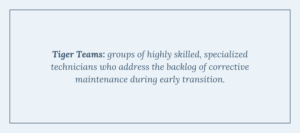
This is where Tiger Teams come in. Tiger Teams are groups of highly skilled, specialized technicians who address the backlog of corrective maintenance during early transition. These teams travel between facilities, providing rapid, expert-level repairs in trades such as:
- HVAC
- Plumbing
- Electrical
- Security electronics
- Fire/life safety systems
- Boiler and chiller systems
Why Tiger Teams Are Critical
For many owners first journeying into outsourced maintenance, the sheer volume and complexity of corrective maintenance that exists in their facilities can be daunting. Tiger Teams help:
- Reduce deferred maintenance quickly
- Stabilize facility operations
- Lessen the burden on permanent on-site staff
- Improve reliability of critical systems early in the program
- Prevent small issues from becoming major failures
- Build trust across agencies by demonstrating immediate impact
These teams accelerate the program’s progress while the long-term preventive maintenance schedule is being structured and implemented. Tiger Teams act as both problem-solvers and momentum-builders – they generate visible improvements that reinforce leadership’s messaging and alleviate operational frustrations.
Key 6: Provide a Career Path for Maintenance Staff
One of the most influential, yet overlooked, benefits of outsourcing maintenance is access to structured career paths. Impactful owners know the importance of investing in people, supporting novices and experienced technicians alike, and offering long-term growth opportunities.
Why Career Paths Matter
- They support employee retention, which is critical given current labor shortages.
- They create pride and stability in the workforce.
- They allow technicians to advance in specialized trades, which improves service delivery.
- They provide clear expectations and continuous performance feedback.
- They signal that maintenance is a valued profession, not a stepping-stone role.
Leading maintenance organizations often implement effective career-building programs, such as:
- Regular one-on-one coaching and performance reviews
- Goal-setting and professional development plans
- Opportunities to gain new certifications and licenses
- Access to broad networks of mentors and skilled tradespeople
- Transparent promotion pathways
When staff know their employer is committed to their advancement, morale strengthens, skill levels rise, and the maintenance program becomes stronger and more resilient.
Key 7: Ongoing Education & Training
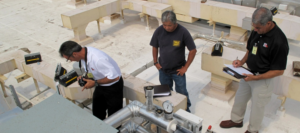
Maintenance professionals need continuous access to training – both to remain safe and to remain effective. Justice facilities especially rely on advanced systems and unique operational environments that require ongoing education.
What You Should Emphasize
- Extensive safety training
- Specialized instruction for secure environments
- Certification requirements
- Technical courses in HVAC, Electrical, Plumbing, and Security Electronics
- Online training accessibility
- OSHA compliance training
- Vendor or manufacturer-specific trainings
Why Ongoing Training Is Non-Negotiable
- Technology changes – so do maintenance expectations.
- Compliance deadlines and inspection cycles require up-to-date skills.
- Safety and security protocols are always evolving.
- Staff must understand high-risk systems such as generators, fire/life safety equipment, and security electronics.
- In the justice environment, improperly trained staff can disrupt operations, compromise safety, or inadvertently violate standards.
What Ongoing Training Should Include
- Annual certifications and recertifications
- CMMS training for accurate reporting and data management
- Hands-on technical workshops
- Safety training (OSHA, confined spaces, lockout/tagout, etc.)
- Continuing education for trades
Ongoing education ensures the workforce stays competent, motivated, and aligned with the agency’s operational expectations.
Setting Your Outsourced Maintenance Program Up for Long-Term Success
Transitioning to an outsourced maintenance model is a multi-step journey with significant operational implications. When approached thoughtfully, outsourcing strengthens not only facility performance but also workplace safety, budget predictability, compliance, staff morale, and asset longevity.
The seven keys outlined in this post form a comprehensive roadmap for success. These steps are mutually reinforcing; when combined, they represent a strong framework for delivering reliable, modern, and sustainable maintenance in justice environments. Your maintenance program should be a strategic asset, not a reactive, fragmented function. With the right preparation and the right partnerships, you can build a model that protects your facilities, supports your mission, and serves your community for decades into the future.
Download the PDF
Meet the Author