

Empowering Staff to Build a Stronger Safety Culture for Facility Maintenance Organizations
“Safety culture” is a term that is often thrown around loosely. When asked, most people say they have a safety culture. In reality, many employees and leaders do not truly understand what a safety culture is or what one looks like. Just because you think you have a safety culture, does not mean that it actually exists. A safety culture starts from the top and works its way throughout the organization. This blog post will help you gain an awareness of what a safety culture truly looks like, and provide practical advice on how to improve the culture in your organization. Let’s explore what a safety culture is, what one looks like, the connectivity between safety and operations, and things you can do to inspire a culture of safety in your workplace.
What Defines a Safety Culture?
To understand what safety culture is, we must define what it means. Many definitions of a safety culture have been published over the years. I prefer the following definition, because it provides an all-encompassing view of the term: “[Safety culture is]the product of individual and group values, attitudes, perceptions, competencies, and patterns of behavior that determine the commitment to, and the style and proficiency of, an organization’s health and safety management and participation”[1]. Notice the keywords within the definition as they are vital in understanding safety as a culture.
Values
Values are guiding principles that define what people deem important, right, and desirable, influencing their decisions and actions. In conversations with employees, many defined values as “ideas and understandings that I have learned that make me who I am.” In a safety culture, values show up in the decisions we make, especially when work is urgent, staffing is tight, or the easiest option is not the safest option. When safety is truly valued, it is not treated as an inconvenience, but as part of doing the job correctly.
Attitudes
Attitudes are learned mental and emotional assessments, encompassing thoughts, feelings, and behavioral tendencies. Our attitudes shape our behavior toward things around us that can affect our lives. They are the outward communications of who we really are. In safety, attitudes show up quickly and decisions must be made as to whether we take hazards seriously, whether we speak up when something feels wrong, and whether we treat safety as a shared responsibility or someone else’s problem. A strong safety culture reflects attitudes that prioritize awareness, respect, and accountability.
Perceptions
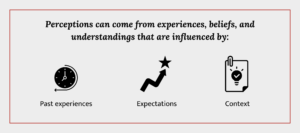
Perceptions are how we organize and interpret information around us. Like personal values, perceptions can come from experiences, beliefs, and understandings that are influenced by our past experiences, expectations, and context. . Safety culture is heavily influenced by perception because people act on what they believe is true. If employees perceive that reporting leads to blame or punishment, they will stop. If they perceive leadership will listen and respond, they will speak up sooner, preventing incidents before they happen.
Competencies
Safety competencies are “the knowledge, skills, behaviors, and attitudes necessary for individuals to work safely and foster a safe environment” – including the understanding of internal policies, operational procedures, and external regulations; the execution of safe work practices; and active participation in continuous improvement through training, feedback, and experience[2]. A strong safety culture pushes individuals to continually develop their competencies. Competencies can be figured out by self-evaluation, peer evaluation, or leader evaluation.
Patterns of Behavior
A pattern is a record of doing something consistently over time. In this context, it is how organizations and individuals treat safety in their environment. Employees, leaders, and customers should be able to easily see this pattern as it is developed over the long term. A pattern of safety requires visible habits of adopting safety practices and risk mitigation. This does not guarantee a 100% accident-free organization but rather one that has a proven pattern of being risk conscious and mitigating them. Facilities maintenance comes with inherent risks. The question is, “How we are addressing the risks and mitigating them to show a pattern of safety continuity?”
Communication
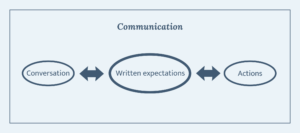
Communication is the final unspoken element that ties all these keyword definitions together. Communication must flow down the chain and back up again through conversation, written expectations, and actions. Communication is not simply a blanket definition that works for everyone – it requires flexible leadership styles and multiple communication methods to ensure messages are received, understood, and acted upon.
What Does a Safety Culture Look Like?
Over the past few years, I have surveyed CGL’s Safety Teams from orientation to their six-month duty, asking them the question, “What is a safety culture and what does one look like?” Aspiring to professional definitions, such as the one listed earlier, are great, but unless employees say you have a safety culture, then you really do not. Remember that perception is a key part of the definition of safety culture. Here are a few great examples of what CGL employees say a safety culture looks like.
Safety Culture is…:
- “…Not forced compliance. Show us safety matters, and we will show it back.”
- “…An awareness that is normal and not a dreaded task.”
- “…Understanding and acting in a safe manner. This is the way we do things in our culture.”
- “…Communicating between each other (coworkers and leaders).”
- “…Communicating with clients as to why we do things.”
- “…Not a group of finger pointers, but rather solution finders to help provide safety.”
- “…Not just a workplace thing; we live this way.”
- “…Attitude and awareness of safety and the processes that go with it.”
- “…A desire to correct unsafe issues.”
- “…Personal as well as a team responsibility – speak up and/or fix it!”
Tips For Building Connectivity Between Safety and Maintenance Operations
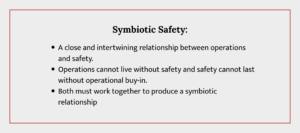
“Symbiotic safety” is the term used for a deep connection between maintenance operations and safety. There must be a close and intertwining relationship between operations and safety. If safety and operations are competing priorities, both lose. If they support each other, performance improves. This type of relationship, promotes a safety culture, with the added benefit of developing a maintenance culture. Here are some tips to develop and strengthen this relationship:
- Be the example, whether you are a leader or an employee.
- Brief the expectations, do not assume everyone already knows them.
- Foster two-way communication between managers and employees.
- Foster employee-to-employee communication.
- Treat operations and safety as one and the same.
- Coach those who need help understanding.
- Be proactive in both maintenance and safety
Practical Steps Toward a Safety Culture
In the end, talk is cheap unless you can back it up. What can you practically do to maintain a safety culture? Below are some tools and actions we have put into place to help build a culture of safety. These approaches are to serve as inspiration and can be appropriately modified to fit other organizations looking to create a stronger safety culture. This list is not all-encompassing. A safety culture is ever-evolving.
Here are some of the things that our safety and operations teams do on a regular basis to develop a safety culture as well as a culture of excellence in maintenance:
Safety Tool Checklist
| Safety Tools | Definition and Rationale |
|
Safety Procedures |
These are written procedures that is available to all employees. This allows all employees access to the safety program. Examples of what employees need to know are procedures on how we do: risk management, HAZMAT, HAZCOM, fall protections, lockout/tagout”, housekeeping, accident reporting, and tool control. These are just a few examples and can be tailored to your industry. |
|
New Hire Briefing |
This is a briefing that new employees get within the first two weeks of reporting to the company, covering HR, safety, and working in corrections. If we do not ensure they understand the standards, then who will? |
|
New Hire Checklist |
This is a checklist designed to guide leaders to go over the organization and its sections with the employee in a one-on-one meeting. Essentially, this is a leader’s briefing to ensure that everything a new employee needs is understood. |
|
New Hire Training |
Training assigned in HR, Safety, IT, and other areas as required by job. Initial training ensures the regulatory requirements are taken care of. Furthermore, this is the time to train on how the company operates. |
|
Weekly Toolbox Talks |
Weekly 10-minute training that employees do as a group. This is an opportunity to ensure employees get more specific training that fills in the gaps of monthly training. Employees get a chance to learn in a group environment. This allows leaders to ensure a particular subject is really understood. |
|
Monthly Training |
Safety training that keeps employees current in safety but also follows the weekly topics to reinforce those subjects. Areas such as HAZMAT, lockout/tagout, fall protection, accident avoidance, etc. must be trained on annually. |
|
Other Training (as required) |
These are identified by managers and assigned or given as needed. In safety, leaders may need specific training that is not covered by the regular scheduled training in the organization. This may be aerial lift, asbestos, lead, electrical, HVAC, and plumbing-specific training. |
|
Local Safety Meeting |
Local safety meetings are held at the lowest levels. These are normally held weekly along with our weekly training. I suggest if not weekly, then at least monthly. This is to go over the hazards and concerns in safety that the employees see at the sites. When given an opportunity, you will find that employees will report issues that are unsafe. I have found that the issues are not normally seen by the safety or local manager. |
|
Safety Manager’s Meeting (monthly) |
This is the leadership safety meeting. This goes over all areas of safety at the executive and leadership levels. This is the chance for the safety manager to put out important safety trends, new information, and general knowledge. |
|
A Sense of Local Ownership and Accountability (all employees and leaders) |
This is constantly briefed to employees and leaders to ensure they know that the majority of issues happen at their level. If they do not report them, there will continue to be issues. It is very important to instill ownership and accountability in all employees. Employees and leaders see issues firsthand and will have great ideas to fix them. |
|
Hazard Log |
This is a log of the issues in the organization and sites. This ensures that communication of the issues is happening. Further, it helps to ensure that the issue is not forgotten.. This should be a record of past and present issues in an organization. Depending on the organization, this can be kept at the organization or the site level. |
|
Job Hazard Analysis |
This is a written document of a common task, the steps involved in the task, the hazards, and what we are doing about them. It is kept in the safety book for all to have access to. |
|
Safety Committee |
This is a committee that is put together with the safety manager, CMMS, and one employee per director. They are responsible for things such as site visits, reviewing safety documentation, and other tasks agreed upon by the leadership. This gives another look at sites and risk mitigation in the organization. |
|
Expectation of Reporting Accidents, Incidents, and Other Issues |
We make reporting a priority. Many organizations have a low number of accidents because they are not being reported. Perhaps because of a negative result, reporting is not a priority, or they do not know they should report accidents, incidents, and safety issues. Unreported issues and accidents cause more severe results later. |
|
Continual Improvements |
We instill an attitude towards ‘making it better.’ This is one of our core values. Encourage employees and leaders to come up with ideas to improve areas of the organization. Once instituted, you will find these are some of the best ideas out there. |
|
Weekly Status Meetings |
This meeting is designed to go over the issues or best practices and try to make things better. Furthermore, it ensures that everyone is informed. |
|
Scorecards |
This tracks maintenance and safety Key Performance Indicators (KPIs). It helps us to get ahead of issues. KPIs can be trackable information that tells us how well we are doing at each site. In safety, we track accident reporting, new hire training completed, monthly and weekly training completed, site visits, new hire briefings completed, and safety committee actions. These will be different depending on the organization and the section of the organization. Look at your organization and decide what is easily tracked that will tell you how you are doing. |
|
Periodic Reevaluation of Company Structure, Procedures, and Written Information. |
Structure, procedures, and other areas of the organization are reviewed periodically so we can stay relevant and current. In safety, this is normally a team effort to ensure everything is still as we do it. Periodically, we review all procedures, job hazard analyses, HAZMAT lists, safety data sheets, and an overall evaluation of how we are doing in safety. |
Employees and Leaders Set the Pace
We can talk about tools and practices all day long, but at the end of the day, a true culture of safety begins and ends with the individual. Whether you are a leader or an employee, the safety and operational culture is set by you. While a culture of safety may start with the leader, each employee plays a key role, particularly those considered to be informal leaders in the organization. These are employees who influence others by their example or abilities.
By taking the time to read this blog post and learn more about safety culture, you are taking the first step to becoming an informal leader when it comes to safety. Keep up the momentum and use the following outline to conduct your own self-evaluation to gain a better view of where you are in regard to safety and operational culture. Some of you may feel you are doing great, while others may not. The key is to realize where you are, enabling you to make the necessary changes in your workplace.
Ask yourself these questions:
- How can I be part of this type of culture?
- Do I understand the list above?
- Where am I lacking in these commitments?
- How do I get help to improve these areas?
- What are my next steps?
Further ideas to help establish my leadership:
Values establish who we are.
- What are the company’s values?
- What are my values?
- What are my employees’/coworkers’ values?
- What are the shared values between all these to help me connect?
Attitudes are our outward appearance of who we are.
- What does my attitude look like to those around me?
- What do I need to do to change a bad attitude?
Competencies are my skills. In this case, in safety and operations.
- Am I lacking in safety and operations skills?
- What is my next step to improve upon what I am lacking?
- Who do I reach out to for help in these areas?
Patterns of behavior are our or the organization’s record of how we are.
- What is our general pattern of behavior?
- Does this represent a safety and operational success?
- What do I need to do to change a negative pattern?
- Who do I reach out to for help in this area?
Communication is the flow of information.
- Do my peers and/or leaders think I am a good communicator?
- If not, what do I need to do to change this perception?
- Am I communicating the ideas in this blog post?
References
-
Churruca, K., Ellis, L. A., Pomare, C., Hogden, A., Bierbaum, M., Long, J. C., Olekalns, A., & Braithwaite, J. (2021). Dimensions of safety culture: A systematic review of quantitative, qualitative, and mixed methods for assessing safety culture in hospitals.BMJ Open, 11(7), e043982. https://doi.org/10.1136/bmjopen-2020-043982
-
Caburao, Eunice Arsilla. (2025). What is safety competence? https://safetyculture.com/topics/workplace-safety/safety-competency
Download the PDF
Meet the Author